Blog
The Chat Window Was Only the Beginning
Most people still imagine the AI revolution as a very visible event. A dramatic new app. A humanoid robot walking onstage. A founder declaring that everything changes now.
But the last few days of announcements told a more interesting story. The shift is already here, and it is arriving sideways.
In Google’s March Gemini Drop, the headline feature was not some theatrical super-intelligence reveal. It was something quieter and more consequential: users can bring over old AI chat history, connect Gemini across Gmail, Photos, and YouTube through Personal Intelligence, and use faster voice conversations that hold context longer. In the same update, Google also pushed creative tools such as Lyria 3 Pro, which can turn a photo or a half-formed idea into a longer, more polished song.
None of that looks like science fiction. That is exactly why it matters.
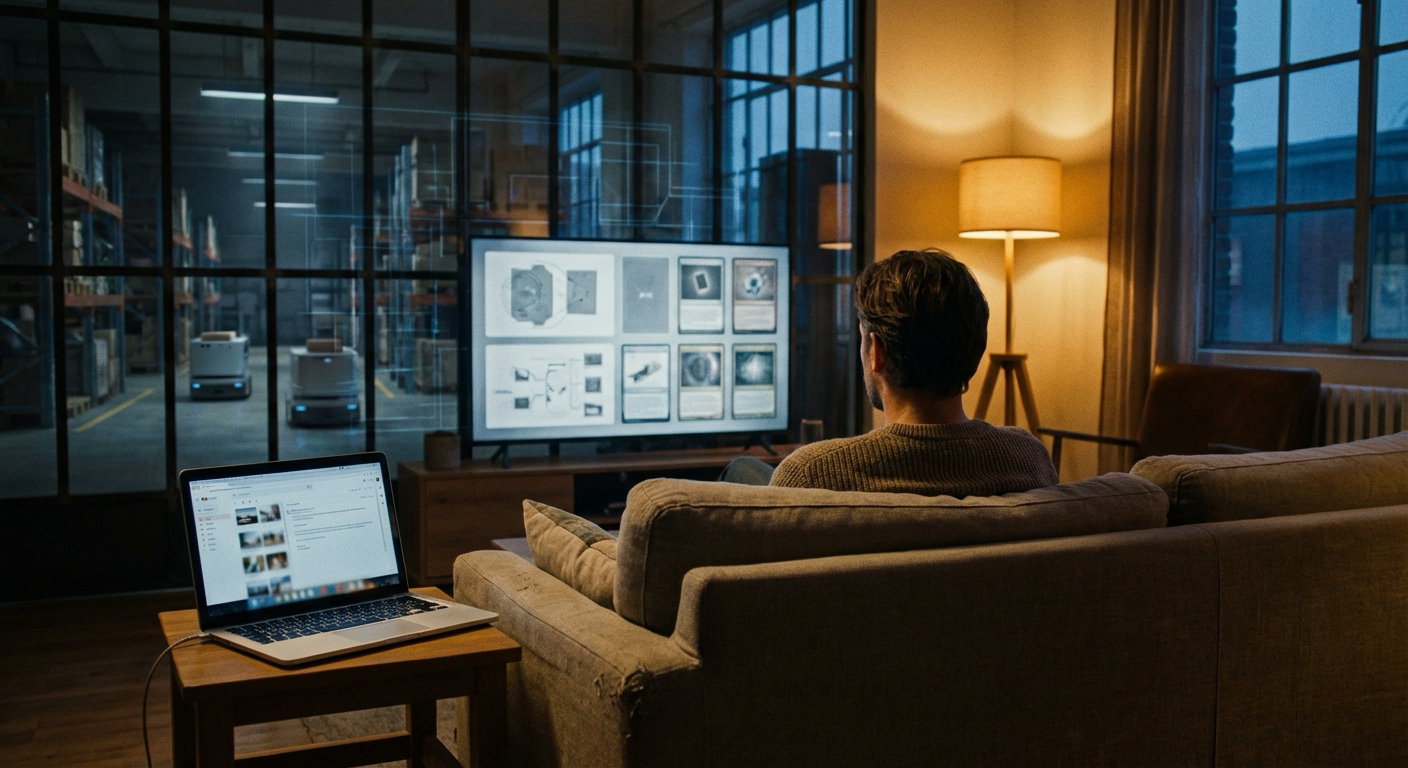
The next wave of AI adoption will not come from people opening a dedicated “AI app” and staring respectfully at the future. It will come from familiar surfaces becoming strangely capable. Your TV explains a topic. Your inbox becomes memory. Your warehouse rehearses reality before anything moves in the physical world.
That is where new use cases are born: not at the edge of spectacle, but inside old routines.
When AI Stops Looking Like AI
A good test for whether a technology is becoming economically important is simple: do people still have to announce that they are using it?
For the first phase of generative AI, the answer was yes. You went to a chatbot on purpose. You prompted it like a machine. You copied and pasted outputs into the real work. Useful, yes. Seamless, not even close.
What is changing now is the interface layer. Google TV’s latest Gemini rollout adds rich visual answers, narrated deep dives on topics like health, economics, and technology, plus sports briefs that assemble updates into a quick spoken catch-up. It sounds modest until you notice the underlying move: the living-room screen is being repositioned from passive entertainment device to conversational explainer.
That is a genuinely new private use case. Families do not need to schedule an “AI session.” They ask a question about cold plunges, matcha, a playoff race, or a recipe, and the largest screen in the house answers with something closer to a guided mini-documentary than a search result.
A few years ago, that would have sounded like a gadget demo. Today it looks like a product category taking shape in plain sight: AI as ambient context, delivered through devices people already trust and understand.
The real leap is not more intelligence in the abstract. It is more intelligence embedded exactly where a decision, curiosity, or bottleneck already lives.
That same pattern shows up in Google’s push to make context portable. Importing prior AI chat history sounds like a convenience feature, but strategically it is bigger than that. It lowers the cost of switching assistants. It preserves accumulated context. It makes an AI relationship feel less like a throwaway session and more like a durable working layer.
Once that layer is connected to email, photos, and personal media, the assistant stops being a novelty and starts resembling an interface to your own life.
The Screen, the Inbox, and the Warehouse
Here is where the story gets properly interesting: the same shift is happening in industry.
At NVIDIA’s GTC 2026 physical AI showcase, the company described robots, vehicles, and factories moving beyond isolated pilots toward enterprise-scale workloads. The flashy part, if you want one, is the robotics language. The important part is the workflow language. NVIDIA’s Physical AI Data Factory Blueprint and digital-twin tooling are designed to help teams generate, test, and evaluate synthetic training environments before those systems ever hit the floor.
That means a warehouse can become a place where AI is not merely deployed but pre-trained in simulation. A robot fleet can be stressed, tuned, and retrained against edge cases before the expensive mistakes happen in public. KION’s work with warehouse digital twins for GXO, cited in NVIDIA’s roundup, points to a future where logistics operations are rehearsed the way software teams rehearse deployments.
That is not just a better robot story. It is a better business-model story.
The valuable use case is no longer “AI can see.” The valuable use case is “AI can practice.” And once machines can practice inside accurate models of the real world, the economics of experimentation start to change. More trials become affordable. More edge cases become visible. More industries gain access to capabilities that used to require absurd amounts of physical testing, data collection, or operational risk.
Seen together, these announcements share a thesis: AI is maturing into a context engine. In consumer life, it assembles your personal signals into help that feels timely and tailored. In industry, it assembles simulated and real-world signals into systems that can learn faster than operations alone would allow.
Different surfaces. Same direction.
The Next Use Cases Will Feel Obvious in Hindsight
The easiest mistake right now is to look for the next AI breakthrough in the wrong shape. People keep waiting for a single killer app, as if the market owes us one neat icon to summarize the transition.
I think the next breakout will be messier and far more powerful than that.
It will look like dozens of small category shifts happening at once. A TV becomes a tutor. A music model becomes a rough-draft studio for people who never touched production software. An assistant becomes a migration layer for your accumulated digital memory. A warehouse twin becomes the cheapest place to discover failure. None of those use cases wins by sounding revolutionary. They win by erasing friction that had quietly become normal.
And that is where the techno-optimist case becomes very strong.
When AI settles into real surfaces, it broadens who gets leverage. You no longer need elite technical taste to benefit from it. You need a question, a workflow, a family routine, a supply chain, a creative itch, a repetitive bottleneck. The interface does the translation work. The product meets people where they already are.
That usually marks the moment when a technology stops being impressive and starts becoming foundational.
So yes, keep an eye on the frontier models and the benchmark charts. They matter. But the bigger signal this week was more practical than glamorous. The new use cases are arriving in the everyday fabric of digital life and physical operations, and they are getting weirdly useful very fast.
The chat window had a great run. It opened the door.
Now the rest of the building is waking up.