Blog
The IDE Is Becoming a Control Plane
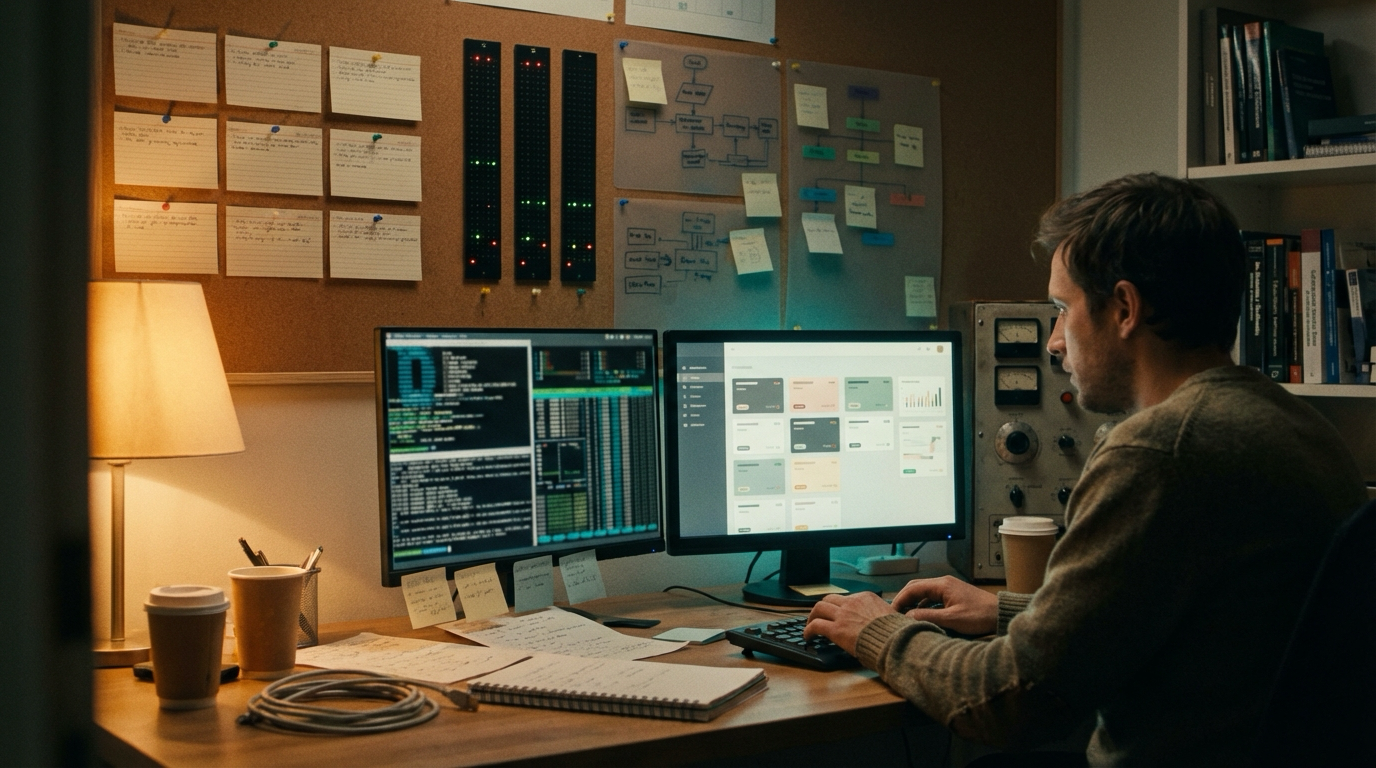
For years, the default story about AI in software was small and tidy. You opened your editor, started typing, and a model floated nearby offering completions, test stubs, and the occasional lucky refactor. Useful, occasionally magical, still clearly subordinate to the human driving the keyboard.
That story is already getting old.
Over the last few days, a cluster of product signals has made the next chapter much easier to see. In OpenAI’s newly updated Codex launch material, the company describes a “command center for agentic coding,” built around parallel work, isolated worktrees, cloud environments, reusable skills, and always-on background automations for things like issue triage and CI/CD. On the same beat, Reuters reported that Microsoft is adding the ability to use multiple AI models inside the same Copilot workflow. And in one of the most revealing field reports I have seen all year, GitHub’s Copilot Applied Science team wrote that five people jumping into a new project produced 11 agents, four skills, and changes across 345 files in less than three days.
Read those together and the pattern is hard to miss: the center of gravity is moving away from code generation as a feature and toward software production as an orchestration problem.
The editor is losing its monopoly
The big shift is not that models got a bit better at writing functions. That part matters, but it is no longer the headline.
The headline is persistence.
Codex is being framed less like a clever inline assistant and more like an operating environment for engineering work: agents can stay active in the background, move across surfaces, share account context, and take on surrounding tasks that used to live in the human backlog. The interesting phrase on the OpenAI page is not “better code.” It is the idea of work being completed “end to end,” from refactors and migrations through review, documentation, and release-adjacent chores.
That matters because the real drag on engineering has never been keystrokes alone. It has been context assembly, repo archaeology, waiting, handoffs, rechecking, half-forgotten follow-ups, and the general entropy that forms whenever a team is juggling product complexity with delivery pressure.
A system that can keep several threads alive at once changes the shape of that burden. One agent can map an unfamiliar codebase. Another can prepare a migration. Another can run and interpret evaluation loops. A human can step in at the points where taste, risk judgment, product sense, or architecture trade-offs actually matter.
The IDE is starting to look less like a workplace and more like an air-traffic tower.
That is a deeper change than better autocomplete. It turns software engineering from a mostly serial craft into something much closer to managed parallelism.
The real breakthrough is workflow, not prose generation
The GitHub post is especially valuable because it reads like field notes rather than marketing copy. The author describes using coding agents to automate a chunk of their own intellectual toil, then lays out the discipline that made the setup work: planning before execution, frequent refactoring, aggressive documentation, strong tests, and a “blame process, not agents” mindset.
That last point is gold.
Teams spent the last decade learning that reliable software comes from good systems, not heroic individuals. The same rule is now being imported into agentic development. If the agent fails, the response is increasingly not outrage or mysticism; it is to tighten the prompts, improve the docs, add the contract tests, clarify the stopping rule, and make the repository easier for the machine to navigate.
OpenAI’s own recent Codex documentation leans in the same direction. In its guide on understanding large codebases, the goal is not a vague summary but a concrete map of request flow, module ownership, risky spots, and the next files worth reading. In its guide on iterating on difficult problems, the emphasis is on explicit evaluation loops, machine-readable scores, stopping thresholds, and a running log that makes long-horizon work trustworthy and resumable.
That combination tells you where the frontier really is. The winning teams are not merely asking models to spit out code faster. They are building environments where agents can reason over structure, inspect artifacts, measure progress, and keep moving without losing the plot.
Once you see that, a lot of familiar debates start to feel strangely outdated. The question is no longer whether AI can write a decent function. Of course it can. The more consequential question is whether your team knows how to turn software work into legible, verifiable, delegable loops.
That is a management problem, a product problem, and a systems design problem all at once.
The next great engineers will feel part architect, part editor, part coach
There is a very optimistic reading of all this, and I think it is the right one.
Software teams are about to gain leverage in the least glamorous parts of the job first. Repo orientation. Scaffolding. Regression hunting. Documentation gaps. Repetitive reviews. Background chores that quietly eat whole afternoons. When that layer starts getting absorbed by agents, the human role becomes more strategic and more interesting, not less.
The best engineers will still care about code, deeply. But their advantage will compound elsewhere too: in decomposition, prompt design, system boundaries, verification strategy, taste, and the ability to create repositories that are easy for both humans and agents to operate inside.
A clean architecture used to be a gift to your future teammates. Now it is also a force multiplier for your machine workforce. Good tests used to protect you from regressions. Now they also act as steering rails for autonomous execution. Clear documentation used to speed up onboarding. Now it becomes executable context.
That is why the teams who benefit most from this wave will probably not be the ones screaming loudest about “replacing developers.” They will be the ones that quietly turn their codebases into agent-friendly systems: explicit contracts, durable logs, reviewable diffs, strong CI, sharp product briefs, and sane approval gates.
And yes, that likely changes the economics of software. Smaller teams will ship more. Specialists will have more reach. Internal tools that once died in the backlog will suddenly become weekend projects. The distance between an idea and a working artifact is shrinking fast.
The bottleneck, however, does not disappear. It moves.
It moves toward judgment. Toward choosing the right problems. Toward deciding what “good” means. Toward building feedback loops strong enough that a machine can sprint without turning the repo into compost.
That is why I am bullish.
We are not watching software engineering get flattened into button-mashing. We are watching it grow a new operational layer. The engineers who learn to run that layer well will look absurdly high-leverage in the next few years. They will spend less time pleading with syntax and more time conducting systems, shaping intent, and pulling finished work out of parallel streams of computation.
The keyboard is still there. It just is no longer the whole job.