Blog
The Post-UI Era: When Enterprise Software Stops Serving Humans and Starts Running Work
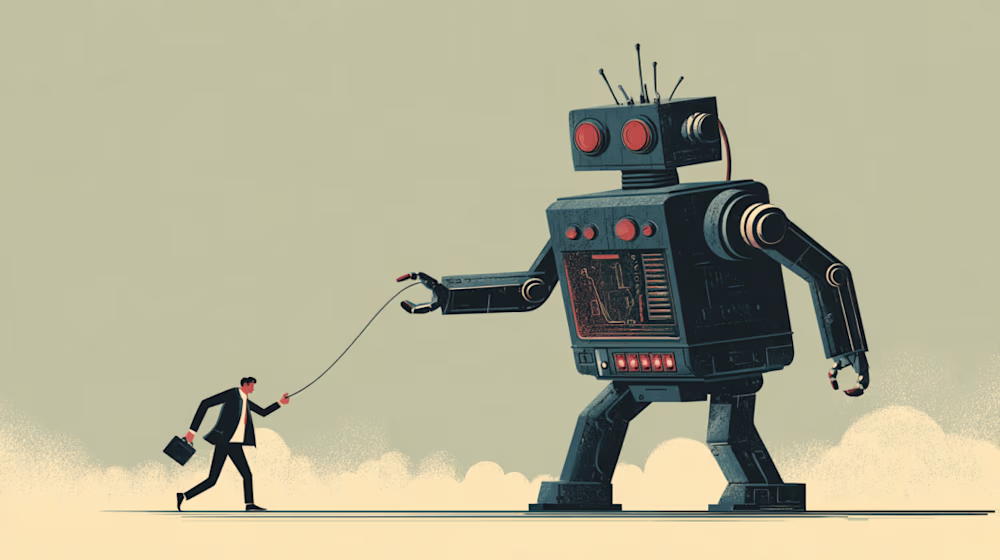
For most of its life, enterprise software has had one job: help a person do a thing.
Click here. Fill that out. Approve this. Export that. Repeat until retirement.
That model is ending. Not because humans suddenly got better at process design, but because software is gaining a new “user” entirely: a digital workforce that does not need dashboards, training videos, or polite reminders.
For 2026, Forrester’s call is blunt: enterprise apps are shifting from user-centric design to process-centric execution, where AI agents do work across systems with less human babysitting.
The real shift: software becomes labor
When you treat technology as labor, everything changes:
You stop buying “features” and start buying throughput.
You stop optimizing screens and start optimizing handoffs.
You stop asking “will users adopt this?” and start asking “will this run reliably at 3 a.m. when nobody is watching?”
This is the part most companies miss. The big story is not prettier copilots in the sidebar. It’s workflows that keep moving even when the human is offline.
Forrester frames 2026 as a decision year: how far do you go in digitizing business processes so they can run independent of human workers, and what do you need to modernize to make that safe and real.
Prediction 1: HR platforms become the manager of “digital employees”
The first prediction is quietly wild: the top five HCM platforms will add digital employee management.
That sounds like a feature announcement until you realize what it implies.
HR systems have always been the system of record for humans. If agents become “workers” that can own tasks end-to-end, then someone needs to track:
what they are allowed to do,
what they actually did,
how they performed,
where they failed,
and how they get improved or retired.
Forrester’s point is that we already got used to task-based automation. The next step is role-based agents that coordinate across multiple systems. That is an opening for HR tech to become the system of record for a hybrid workforce, with real planning and analytics behind it.
The optimistic angle: this is the first time in decades that workforce planning can become more than guesswork and politics. If you can measure capacity across humans and digital workers, you can finally design work around reality instead of org charts.
Also, this is not just a “big enterprise” thing. Forrester notes the midmarket may feel the productivity pressure earlier and move faster.
Prediction 2: Enterprise vendors expose themselves to agents with MCP servers
Next: Forrester predicts 30% of enterprise app vendors will launch their own MCP servers (Model Context Protocol servers).
This matters because it pushes the market toward an open-ish ecosystem where you are less trapped inside one vendor’s AI. The MCP server acts like a hub so external agents can securely connect, pull context, and coordinate work across apps using the vendor’s platform and APIs.
The optimistic angle: this is how you get from “a bunch of AI experiments” to something you can actually scale. If the integrations are standardized, you can mix the best agents for each job without turning your stack into a fragile science project.
Forrester also ties this directly to governance: interrogate your vendors on their MCP approach because it starts to address the messy reality of agent access and control.
Prediction 3: ERP vendors ship autonomous governance, because regulators and reality show up
Third prediction: half of enterprise ERP vendors will launch autonomous governance modules.
These modules bundle things companies keep pretending they can bolt on later:
explainability,
automated audit trails,
real-time compliance monitoring.
Why now? Forrester points to three pressures converging: autonomous processes touching mission-critical transactions, very public failures in financial services, and rising AI regulation. They also call out major vendors already investing heavily in governance infrastructure.
The optimistic angle: “governance” has been treated like paperwork. Agentic workflows force it to become product quality. The winners will ship compliance-ready platforms; the laggards will watch customers leave.
There is a practical warning here too: governance modules will introduce licensing costs, integration work, and training overhead.
That is not a reason to stall. It is a reason to plan like an adult.
Reality check: we’re not at fully autonomous business units yet

Forrester makes a useful distinction: the obstacles are real, but not mystical. We are still a few years away from systems that can independently run an entire business unit with human-level adaptability.
At the same time, the enabling constraints are loosening fast: compute, storage, and legacy integration are getting less brutal.
So what is left? The unglamorous work:
business process standardization,
data fragmentation cleanup.
This is where strategy becomes architecture. If your processes are inconsistent and your data is scattered, autonomy turns into chaos. If your processes are clean and your data is coherent, autonomy turns into compounding advantage.
What to do with this, if you want the optimistic outcome
If 2026 is the year enterprise software starts hiring digital workers, the playbook is straightforward:
Modernize the stack where work actually flows. Break out of rigid legacy constraints so cross-system workflows can exist without heroic effort.
Treat governance as a first-class product requirement. Choose vendors that are building autonomous compliance and auditability, not just flashy assistants.
Build for a hybrid workforce on purpose. Workforce planning is no longer just headcount and budgets. It becomes capacity planning across humans and digital workers.
Standardize processes and fix the data. That is the real foundation for autonomy at scale.
The best version of this future is not “humans replaced.” It’s humans upgraded: fewer mechanical tasks, more leverage, more time spent on decisions that actually matter.
Enterprise software had its UI era. The next era is quieter. Less clicking. More execution.
And if you do it right, it’s not scary. It’s freeing.