Blog
When Software Stops Asking You to Tap
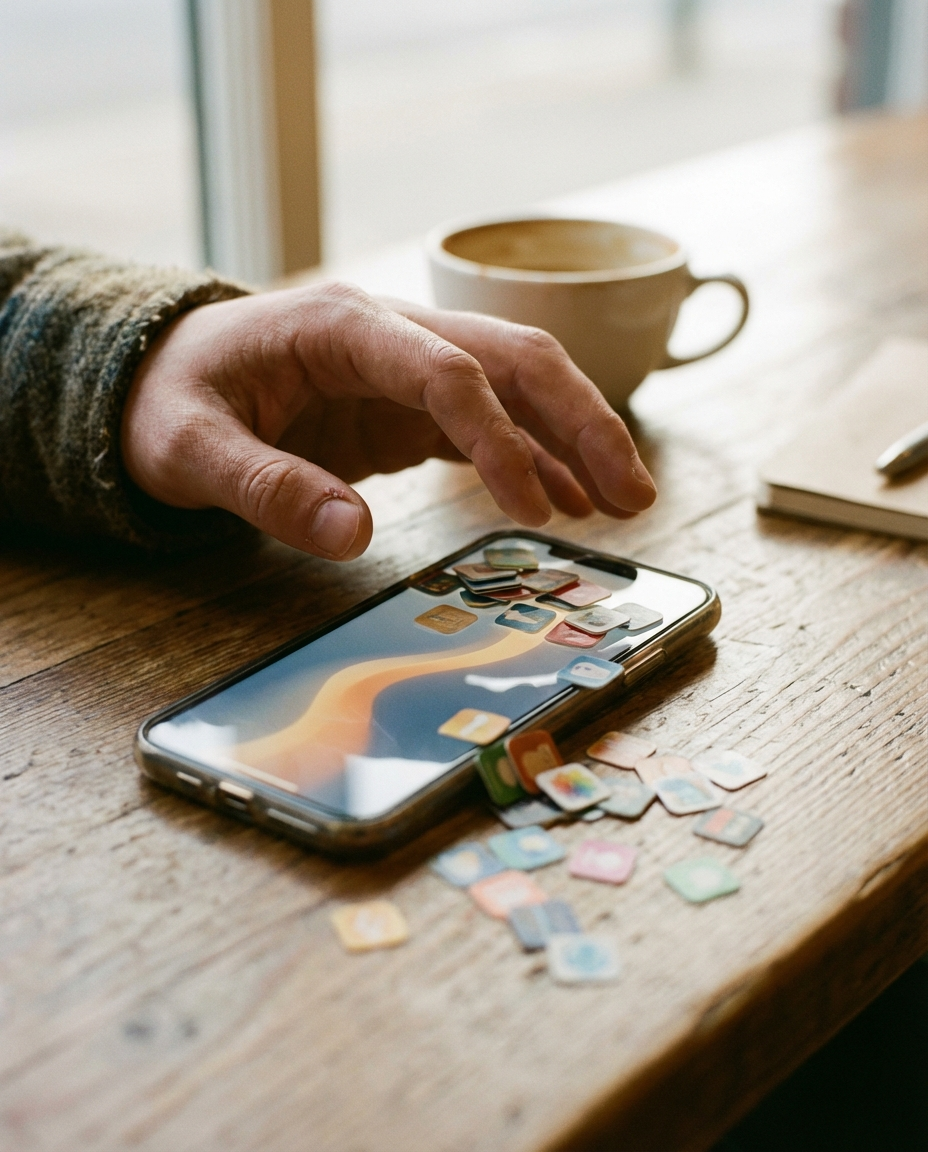
For years, we treated the app icon as the atomic unit of digital life. Need a taxi? Open one app. Need a note? Open another. Need to translate a message, move money, answer email, edit an image, book a meeting, compare three products, and follow up with someone? Congratulations: you have just become a part-time workflow router.
That model worked because software needed explicit instructions and humans were stuck doing the glue work.
Over the past few days, three fresh signals landed from very different corners of the industry. Google’s latest Stitch update turns software design into a voice-and-canvas collaboration where you describe goals and business intent instead of nudging pixels one click at a time. Apple’s iPhone 17e announcement pushes Apple Intelligence further into the live surface of the phone, with on-screen visual intelligence, live translation, call screening, and Hold Assist. And at NVIDIA GTC 2026, the company framed the next hardware wave around agentic AI, with full-stack systems designed for assistants that reason and act across more of the computing stack.
These are not isolated product updates. They rhyme.
They point to a near future where the interface is no longer the destination. It becomes a thin negotiation layer between your intent and a system that can actually do things.
The old center of gravity is moving
Menus were a brilliant answer for dumb software. They are a mediocre answer for smart software.
The interesting part of Google’s Stitch announcement is not merely that it generates UI faster. The deeper idea is that the tool now accepts richer human input: objectives, examples, voice, evolving context, multiple directions at once. That matters because it mirrors how people really think when they are making something. We do not always know the exact sequence of buttons we want to press. More often, we know the feeling we are aiming for, the constraint that matters, the audience we are designing for, or the outcome we need by Friday.
That same shift is creeping into mainstream consumer computing. In Apple’s description of the newest Apple Intelligence features, the notable change is not one flashy demo. It is the spread of ambient utility: your phone can translate live conversations across Messages, FaceTime, Phone, and AirPods; inspect what is on your screen; screen unknown callers; and wait on hold for you. None of that requires a new religion around gadgets. It removes micro-jobs people never actually wanted.
That is the real product shift: software is getting better at understanding what the human meant, not just what the human clicked.
The next interface will still have buttons. They just won’t be the main character.
For consumers, this means fewer app-switching rituals and more outcome-oriented computing. For companies, the moat starts moving away from “we own a destination” and toward “we can help complete a job, wherever the user happens to be.” That is a more volatile game, and a far more exciting one.
The turn: intelligence alone is not enough
There is a tempting, lazy version of this story where better models simply sprinkle magic over existing products and everything feels smoother. Reality is more interesting.
If software is going to move from passive interface to active collaborator, it needs an entirely different substrate. It needs cheaper inference, lower latency, persistent context, stronger permission models, reliable tool use, and infrastructure built for systems that do not merely answer questions but carry state across a chain of actions.
That is why NVIDIA’s GTC messaging matters so much here. Beneath the spectacle, the company is betting hard on agentic AI as an architectural shift, not a feature category. Jensen Huang described exploding compute demand and introduced systems like Vera Rubin as full-stack infrastructure for the next generation of agents. Strip away the keynote theater and the signal is straightforward: the industry expects far more software to watch, reason, retrieve, decide, and act in loops that look much closer to delegated work than classical search.
A future assistant cannot feel like an intern with amnesia. It needs memory of what you were doing, awareness of the tools in front of it, and judgment about when to ask for approval versus when to proceed. That pushes product design into a new discipline where UX, model behavior, policy, and systems engineering all blur together.
The winners here may not be the loudest demo merchants. They may be the teams that make delegation feel trustworthy.
Because that is the crux of the whole thing: once software starts acting on your behalf, competence is only half the story. The other half is confidence. Can I see what it is doing? Can I interrupt it? Can I grant narrow permissions? Can it recover when the world gets messy? Can it show me the receipt, not just the answer?
Those questions used to sit at the edge of product design. They are heading for the center.
What changes next
In the next couple of years, I expect the most important interaction change to be deceptively simple: people will spend less time navigating software and more time briefing it.
That sounds small. It is enormous.
The worker of the near future will increasingly define goals, constraints, and taste, then review and steer execution. The founder will sketch a business flow in natural language and have a prototype by lunch. The insurance analyst, the teacher, the operations lead, the recruiter, the salesperson, and the engineer will all keep their domain knowledge, but a growing chunk of interface friction will dissolve underneath them.
Some industries will resist. Many incumbents will pretend the app grid still has another decade at the center of everything. I would not bet on that. Once people get used to software that can translate, screen, summarize, draft, compare, and route without ceremony, the appetite for manual digital admin starts to collapse.
There will be bad versions of this future, of course: noisy assistants, creepy overreach, permission sprawl, fake autonomy wrapped around brittle workflows. But the direction still feels overwhelmingly positive. The best systems will make computers feel more like good operators: fast, context-aware, transparent, and pleasantly boring in all the right places.
That is why the most important technology story right now is not any single model release or device launch. It is the steady redefinition of what interacting with a computer even means.
We are moving from command lines to graphical interfaces to mobile touch. The next layer looks more fluid: voice when it helps, text when it is precise, visual understanding when the screen already contains the context, and autonomous follow-through when the task is repetitive enough to delegate.
The screen is not disappearing. The app is not dead. But both are being demoted.
And honestly, good.
Computers were never the point. Getting something done was the point. As software gets better at meeting us at the level of intent, the machine recedes a little further into the background, where it belongs. That is not the end of interaction design. It is the beginning of a far more human one.