Blog
The Hand Wins
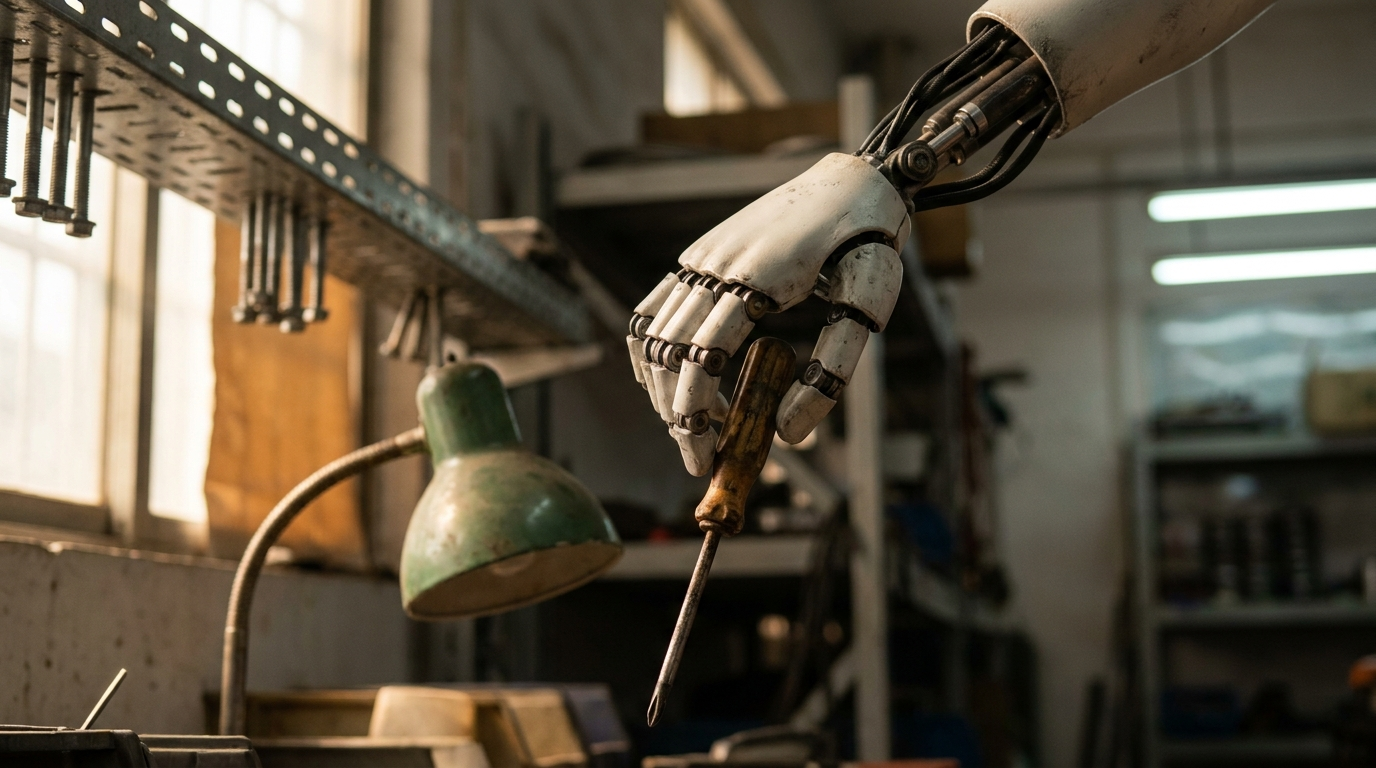
The Screwdriver Problem
For the better part of three years, the loudest argument in artificial intelligence was about language. Who had the most tokens. Who could pass the most benchmarks. Who could imitate a lawyer, a coder, a poet, a therapist, all in the same session. That argument is now over. It ended in the last 72 hours, and almost nobody noticed.
What ended it was a screwdriver.
A Guardian feature published on July 6 reports that China has made the most aggressive bet in modern industrial history on solving the hardest problem in robotics, the same problem Honda, Toyota, and SoftBank have been chipping away at since the Asimo era: a robotic hand that can manipulate the physical world with anything close to human dexterity. The piece does not romanticize the work. It describes a national program of subsidies, university partnerships, and a hundred small Shenzhen component shops iterating on tactile sensors, tendon drives, and fingertip force feedback at a speed the West has not matched.
This is the screwdriver problem. Not whether a model can write you a memo. Whether a robot can pick up a screwdriver, hold it correctly, and drive a screw into a panel. Every factory in the world depends on that motion. Every warehouse. Every kitchen. Every construction site. If you can solve that motion, you have solved the physical economy. If you cannot, the entire "AI is coming for your job" thesis has a polite asterisk next to it.
The asterisk just got smaller.
The Vignettes That Tell the Story
Five stories published between July 4 and July 7, none of them in conversation with each other, all of them in conversation with the same point.
The New Yorker, also on July 6, asks, in print, whether humanoid robots are ready to be deployed. The question mark is doing a lot of work. The article concedes the answer in its first three pages: yes, for narrow tasks, no, for general autonomy, and the gap is closing in months, not decades.
The IEEE Spectrum, also on July 6, runs a quieter piece with louder implications: Japan's humanoid legacy, built on Honda's Asimo and SoftBank's Pepper, is being inherited by China. The labs in Tokyo still have the IP. The labs in Shenzhen have the supply chain, the volume, and the willingness to ship imperfect units into the field and iterate. The piece never says "we lost." It does not need to.
The Wall Street Journal, on July 4, runs an even quieter piece about safety standards. Nobody knows yet what "safe" means for a 1.7-meter machine that weighs 60 kilograms and shares a hallway with a five-year-old. The standards bodies in the U.S. and Europe are working on it. The Chinese vendors are not waiting. They are shipping to factories with internal safety cages, collecting incident data, and writing the de facto standard by doing the work.
The Reuters wire, on July 4, reports that UBTECH has launched a line of consumer companion robots aimed at households. The price point is not given, but the framing is. The product exists. The product is for sale. The product is in the same category as a washing machine, not a research prototype.
The Goldman Sachs Exchanges piece, on July 6, updates the bank's labor thesis. The new concession, buried about halfway down, is that physical labor is now in scope. Not imminent displacement, but in scope. The previous Goldman framing was that AI would touch white-collar work and leave the trades alone. The new framing is that the trades are next, and the timeline is shorter than the bank's prior estimates.
The Bear Case Just Flipped
For most of the last three years, the bear case for incumbent labor markets has been "the machines cannot do it." A robot cannot fold a shirt, sort a bin of mixed parts, install a windshield, change a bedpan. The bear case for incumbent labor markets has now quietly inverted.
The machines are doing it. Slowly. Imperfectly. In narrow tasks. In supervised loops. With a human supervisor somewhere in the chain, often in a control room, often watching a screen. Slowly enough that the displacement numbers, in the next two years, will be small. Slowly enough to deny.
But the trajectory is set. The cost curve on the hand is the same cost curve that ran through integrated circuits, lithium batteries, and solar panels. Every year, the price falls. Every year, the precision rises. Every year, the tasks that were "too hard" become "merely expensive." And every year, somewhere in Shenzhen, a tactile sensor gets a little better, and a tendon drive gets a little cheaper, and a thousand small workshops ship a thousand small improvements into a thousand small robots.
This is the pattern that took the model from a research curiosity to a commodity in roughly four years. The same pattern, applied to a body, is what decides the next decade.
Three things follow, in order of certainty.
First, the global industrial map reorders around who can manufacture at scale. China is currently the only country that can ship a humanoid robot in volume at a price that a mid-sized factory can absorb. Japan has the IP and the cultural patience. The U.S. has the capital and the software, but the supply chain is missing. Europe has the regulatory patience and the safety expertise, which matters more than anyone is willing to say.
Second, the labor displacement numbers will lag the deployment numbers by about three years. The reason is bureaucratic. Procurement takes time. Training takes time. The reorganization of a warehouse around a humanoid workforce takes time. The headlines about "robots took your job" will land in 2028 and 2029. The robots that took those jobs were deployed in 2026 and 2027. The reader of the 2028 headline should know that the actual displacement is already three years old.
Third, the economy of 2030 looks less like the knowledge economy of 2020 and more like an electro-mechanical economy, with a robot in the loop on every physical task and a model behind the eyes of every machine. The white-collar work that survives is the work that touches the robots, designs the robots, finances the robots, and writes the policy for the robots. The work that does not survive is the work that does not touch the robot, in any way, at any layer.
The hand wins. The hand was always going to win. The only question was when, and where, and in whose factory. The answer, this week, is: now, in Shenzhen, in yours.