Blog
AI’s New Nervous System Arrived This Week
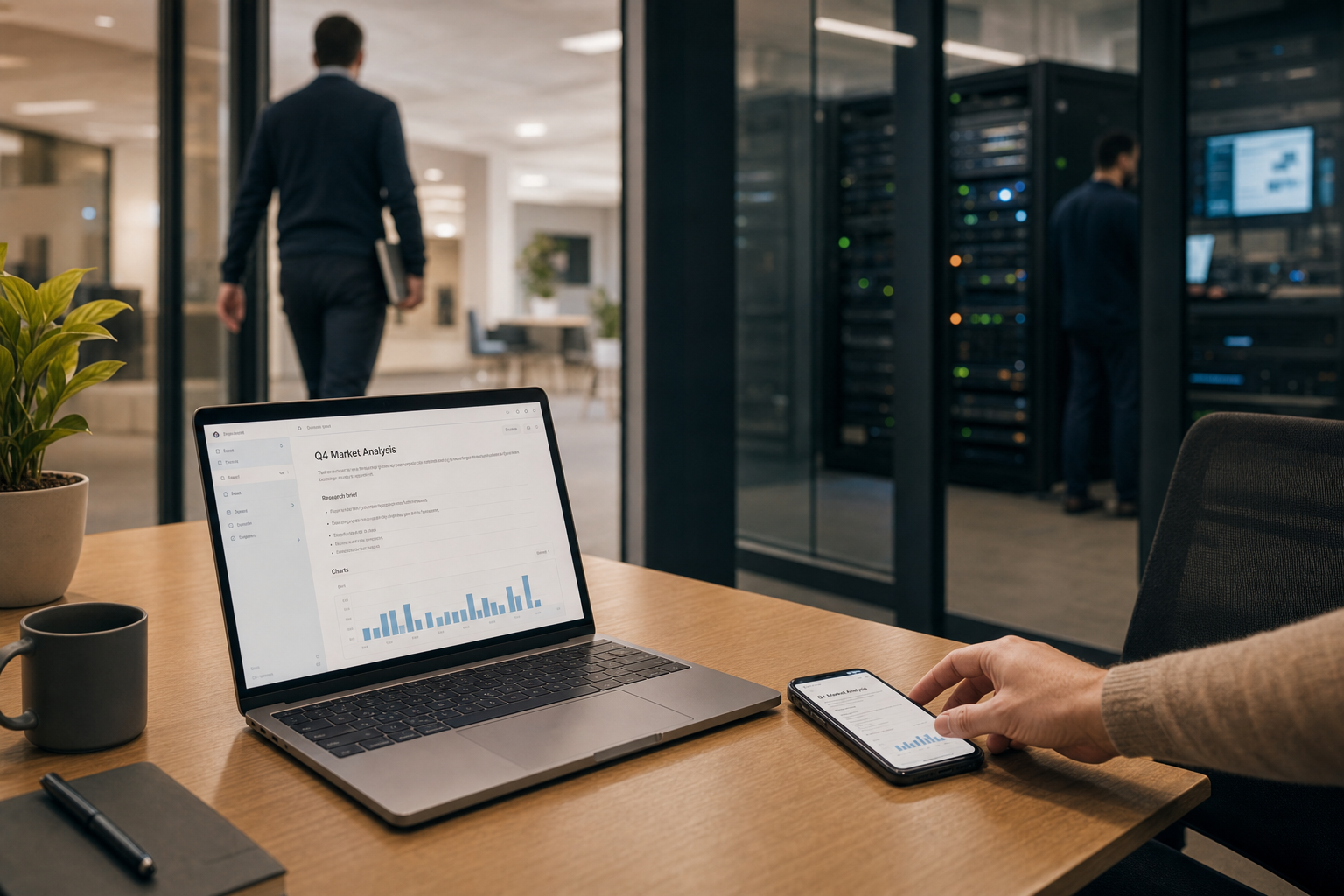
You can feel a market growing up when the announcements get slightly less cinematic and much more consequential.
For two years, AI news has mostly been about the visible layer: smarter models, cleaner chat interfaces, higher benchmarks, prettier demos. That phase mattered. It built belief. It got millions of people to try systems that would have sounded absurdly ambitious not long ago.
But belief has a shelf life if the software can’t travel.
The reason so many AI pilots stalled after the demo was never a lack of raw intelligence. It was the gap between a dazzling answer and a system that could actually reach the right tools, inherit the right context, survive across devices, and operate near protected company data without everyone having a mild security panic.
That gap started closing in a serious way this week.
The boring layer just became the exciting one
The cleanest example was Anthropic’s acquisition of Stainless. On the surface, SDK generation and API plumbing sound like back-office work for people who enjoy reading HTTP logs on purpose. In reality, that layer determines whether agents stay trapped as clever chat windows or become reliable participants in actual software systems.
Anthropic said the useful future for agents depends on access to the systems where work already lives, and Stainless has been building exactly that bridge through SDKs, tooling, and MCP-ready integrations. That matters because the next wave of value is not going to come from asking a model one better question. It is going to come from giving software the ability to move through environments with less friction and less custom glue.
There is a deep lesson hiding here: once the leading AI labs start buying infrastructure rather than just announcing new capabilities, they are telling you where the bottleneck moved.
The bottleneck moved below the model.
That is usually the moment when a technology stops feeling experimental and starts becoming inevitable.
Agents are learning to travel
The second signal came from GitHub, which quietly shipped one of the most practical ideas in the category: take your local GitHub sessions anywhere. It sounds simple until you notice what it changes. A coding session that begins in the CLI can now stay alive as you move between VS Code, the web, and mobile. You can monitor it, redirect it, approve it, and finish it without treating every device switch like an amnesia event.
That is a much bigger deal than it first appears.
A lot of current AI products still behave like sealed rooms. You enter one interface, do one burst of work, then lose continuity the moment you change context. Human work does not happen that way. Real work spills. It starts at a laptop, gets checked in a browser, gets nudged on a phone, gets revisited at night, and often depends on surrounding artifacts rather than a blank prompt.
GitHub reinforced the point with its new Copilot on web context flow, where repositories, issues, and pull requests can travel with the conversation automatically and even become the starting point for agent sessions. That is the shape of the next product era. The prompt is no longer the product. Context packaging is.
When agents can keep the thread, the software starts to feel less like a novelty assistant and more like a collaborator with object permanence.
That is when habits change.
Enterprise gravity is finally a tailwind
The third signal is where all of this gets real: deployment inside institutions that have too much at stake for toy workflows. OpenAI’s new partnership with Dell to bring Codex into hybrid and on-premises enterprise environments is the clearest version of that story. For years, enterprise AI adoption has been slowed by the same set of objections: data residency, internal systems access, governance, security review, compliance drag. Those objections were never glamorous, but they were absolutely decisive.
When the infrastructure starts moving to meet enterprise reality instead of demanding that enterprise reality bend around the model, the addressable market expands dramatically.
Anthropic made that institutional turn even more visible with its new strategic alliance with KPMG, which puts Claude into KPMG’s Digital Gateway and across a workforce of more than 276,000 people. That is not a lab demo. That is organizational muscle memory being retrained at scale.
And here is the part that should make builders pay attention: big rollouts like this do not happen because executives were hypnotized by benchmarks. They happen because the surrounding stack is finally becoming serious enough to support trust, continuity, and control.
The industry spent the last stretch proving that AI can think in surprisingly useful ways. The announcements from the past few days suggest the next stretch will be about something more powerful: AI that can stay attached to the work.
That sounds mundane right up until you realize what it unlocks. Once agents can move across devices, retain the relevant operational context, plug into production systems, and live inside enterprise boundaries, adoption no longer depends on heroic behavior from early adopters. The defaults start improving. Workflows compress. Entire categories of coordination overhead begin to look optional.
That is how step changes usually arrive in technology. Not as one giant fireworks moment, but as a set of infrastructure shifts that make a whole new level of capability suddenly practical.
This week felt like one of those moments.
The future of AI is becoming less theatrical and much more powerful. It is turning into connective infrastructure for human ambition. And once that nervous system is in place, the visible breakthroughs tend to compound very quickly.