Blog
Graph Engineering
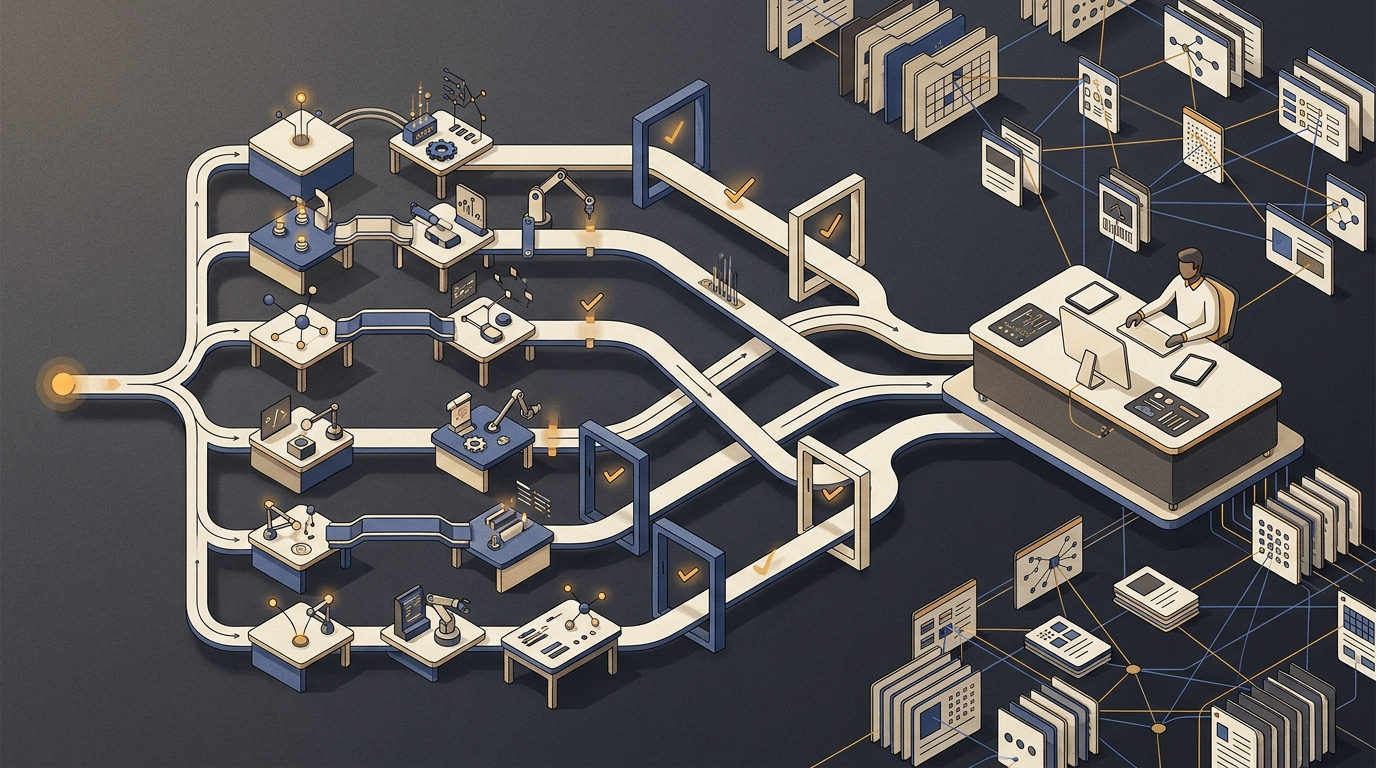
Over the past month, “graph engineering” has appeared in articles from LangChain, Fluxtion, HydraDB, and several independent builders. The phrase is new. The problem is old: software made of locally sensible parts can still behave badly as a whole.
A model can add a handler, call an API, add a retry, update state, and connect a queue in minutes. Each change can look fine alone. The system fails later, when ordering, retries, parallel work, permissions, and shared state collide. Graph engineering makes that work visible before the user discovers its hidden rules through a failure.
The graph is a product decision
The basic vocabulary is simple. A node does one bounded piece of work. An edge says what can happen next and what state crosses that boundary. The graph can contain ordinary code, retrieval, a model call, a full agent, a policy check, or a human approval.
The useful question is not whether a workflow contains a graph. Every workflow does. A sequence of prompts is a graph with one narrow path. The useful question is whether the important dependencies are explicit.
That distinction runs through LangChain’s three-year account of building LangGraph, published July 22. LangChain describes nodes as code, model calls, tools, or entire agents, with deterministic and conditional edges controlling the route. The point is a controlled mixture: let the model reason where judgement helps, and let code enforce the parts that should not be improvised.
The article also gives graph engineering a useful limit. Generic deep research is often too open-ended for a fixed graph. A research agent may discover new leads or decide how many workers it needs. A loop is better there. A support workflow that classifies a case, checks policy, requests approval, and issues a refund has a shape worth declaring.
This is the first implication for output: a graph changes what “good” means. The output is no longer only the final paragraph, code patch, or decision. It includes the path, the evidence collected, the checks passed, the budget consumed, and the point at which a human could intervene. That makes quality inspectable instead of mystical.
Faster work creates a new failure surface
The clearest recent explanation, Graph Engineering with Claude, published July 29, focuses on the fake-edge test. If step B never uses anything produced by step A, the arrow is a delay, not a dependency. Delete it and run both jobs together.
This is why the diamond pattern keeps showing up: fan out independent work, check the results, then synthesize them. Research, competitor analysis, code review, and market scanning all have this shape. Latency approaches the slowest independent branch rather than the sum of every branch.
The catch is that parallelism removes some of the natural places where people notice errors. A bad result can arrive beside three good ones and disappear into the synthesis. Mahax identifies the checker node as the missing piece. The checker needs a bounded contract, a clean context, and permission to reject, retry, or quarantine an output before it reaches the merge.
That has a direct effect on usability. A graph-backed product can show which branches are complete, waiting, or rejected. It can offer “retry source three” instead of “start the entire research task again.” It can pause at an approval node on Thursday and resume on Friday without forcing the user to reconstruct the conversation. Waiting becomes a state the product can explain.
The user interaction changes too. Humans stop being emergency exception handlers and become explicit nodes. In a compliance workflow, approval is part of the path. In a coding workflow, review is a checkpoint with inputs, diffs, tests, and a defined next edge. The system can ask for one decision instead of presenting a finished action and hoping the user catches the dangerous part.
This is also where graph engineering runs into ordinary distributed-systems work. Fluxtion’s argument that graph engineering needs a compiler is valuable because it pushes past the diagram. A visible graph still leaves questions about execution order, reentrancy, failure handling, state visibility, replay, and cleanup. Fluxtion’s proposal is to derive a specialised orchestrator from explicit component relationships and event semantics, producing inspectable generated code.
The broader lesson matters more than that implementation. A graph is a contract only when its execution rules are part of it. Otherwise the team has replaced hidden callbacks with a pretty picture and moved the ambiguity one layer up.
The business case is shared meaning
The most useful distinction in the recent cluster appears in HydraDB’s account of execution graphs and context graphs, published August 13. An execution graph answers “what runs next?” A context graph answers “what does the system know?” Those are different questions, with different owners and lifetimes.
This matters because workflow state is easy to mistake for business truth. A checkpoint can resume a run. A transcript can preserve a conversation. A memory store can influence the next model call. None of those, by itself, says which record is the canonical customer, which contract superseded another, who approved a decision, or what was true when the agent acted.
That distinction changes the business cases worth pursuing. A small team can gain from an execution graph for support triage, document processing, code review, research, and internal operations. It improves throughput, localises failures, and gives managers an audit trail they can read.
A durable context graph becomes valuable when several agents, sessions, or applications must update the same facts. Think customer renewals across CRM, billing, and support. Think claims where policy, evidence, adjuster decisions, and payment status must remain connected. Think software incidents, deployments, owners, and approvals that must survive the retirement of one agent framework.
That is where the moat moves. It is not the number of nodes in the workflow. It is the domain contract underneath them: stable identity, typed relationships, provenance, temporal validity, permissions, and conflict rules. HydraDB is making a product case for graph-native context infrastructure, but the underlying requirement applies whether the storage is graph-native, relational, event-sourced, or hybrid.
There is a cost boundary too. Anthropic’s engineering report on its multi-agent research system found a 90.2% improvement over a single-agent baseline on one internal research evaluation, while multi-agent systems used roughly 15 times as many tokens as ordinary chat. Parallel work pays when the task has enough value, breadth, or tool complexity to justify the bill. It is a poor default for tightly coupled tasks where every branch needs the same changing context.
That gives graph engineering a practical shape. Use an explicit execution graph where the route is valuable to control, inspect, retry, or explain. Keep dynamic loops inside nodes where discovery matters. Add a durable context layer when the business needs shared meaning across workflows. Put budgets, permissions, provenance, and approval state on the edges that can cause real-world consequences.
The emerging skill is not drawing more boxes. It is deciding which parts of the system may reason, which parts must enforce, and which facts must outlive the workflow that first touched them. Once those decisions are explicit, AI output becomes easier to test, cheaper to operate, and easier for a user to trust.