Blog
Stop Hiring AI as a Junior Employee and Start Pointing It at the Alien
For three years, product decks have recycled the same AI story. A model drafts the email, summarises the meeting, writes the first pass of the code, and cleans up the pivot table. The synthetic junior employee is cheaper, faster, and always available.
Those products can be useful, but they also keep our ambition trapped inside the shape of work we already understand.
The more interesting systems do something different. They search combinations of atoms that no laboratory could test one by one. They detect structure in animal calls without a bilingual dictionary. They let a family turn decades of recordings and letters into a conversational archive. These systems reach into spaces that were previously too large, too strange, or too personal to query.
That suggests a better brief for builders: stop asking which familiar task a model can imitate. Ask which valuable problem has remained untouched because humans could not see enough of it.
A map of matter humans never had
In 2023, Google DeepMind reported that its Graph Networks for Materials Exploration system, GNoME, had identified 2.2 million candidate crystal structures. The researchers estimated that 380,000 of them were stable enough to justify further investigation. DeepMind described the increase as roughly equivalent to 800 years of accumulated knowledge.
The number is startling, but the mechanism matters more. Materials discovery has a search problem. The possible arrangements of elements are vast, while synthesis in a laboratory costs time and money. Researchers therefore need to decide which candidates deserve an experiment before they know whether those candidates will work.
GNoME learned from known crystal structures, generated candidates, and ranked their predicted stability. It did not prove that all 380,000 stable candidates can be manufactured or that any particular one will become a better battery or solar cell. Experimental teams still have to synthesise, test, reject, and refine them. The model changed the front end of that process by supplying a much larger, better-prioritised map.
That distinction matters commercially. “AI for chemistry” sounds like another efficiency tool. A ranked catalogue of plausible matter creates different possibilities: scouting compounds for a specific industrial property, licensing validated materials, or building automated laboratories that move candidates from prediction to synthesis. The defensible asset includes the feedback loop between model and experiment, not merely access to a model.
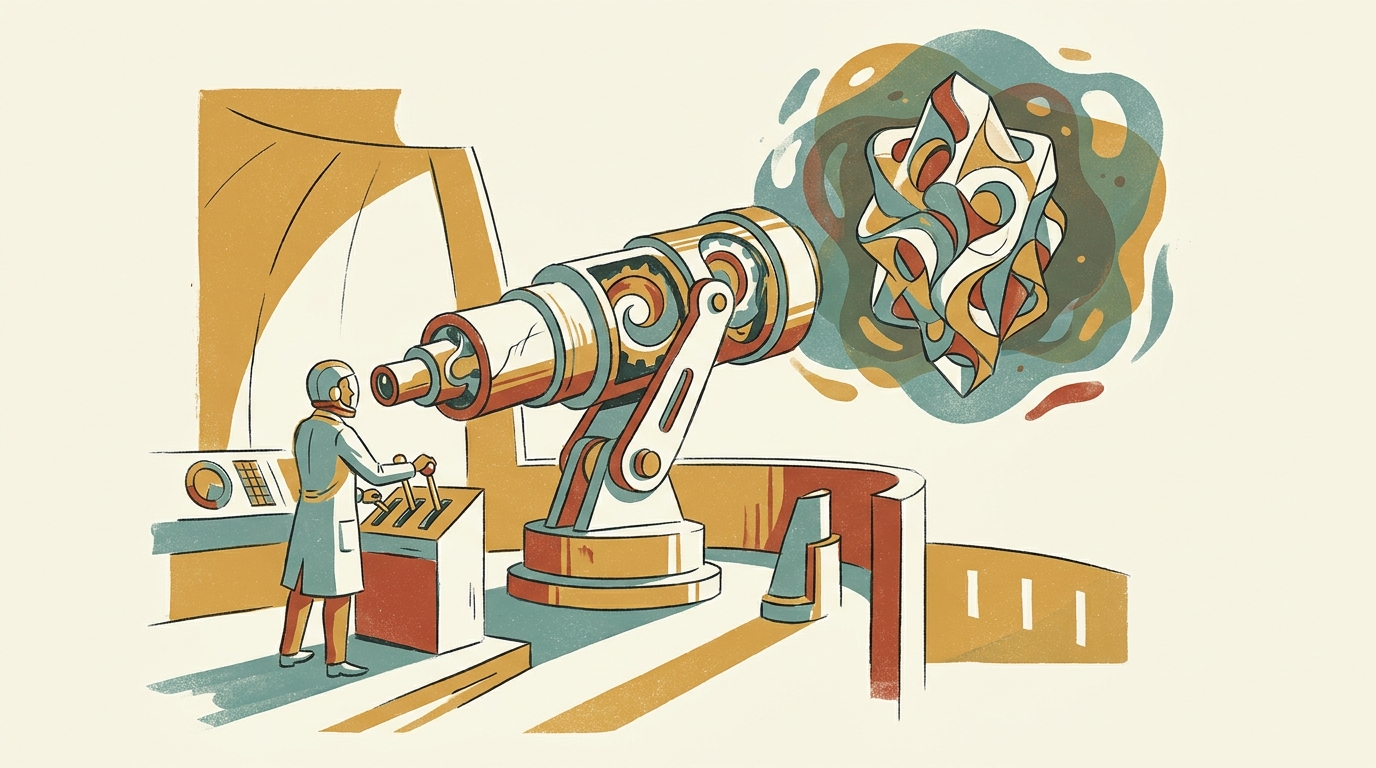
The telescope comparison is useful here. A telescope does not automate astronomy. It reveals objects that astronomers could not inspect before. GNoME gives materials researchers a wider field of view, then leaves the hard work of verification firmly in the physical world.
Signals without a Rosetta Stone
Animal communication poses a stranger search problem. Humans can collect thousands of hours of clicks, whistles, calls, and movements, yet we lack parallel corpora that pair an animal signal with a human sentence. There is no whale edition of a language textbook.
As Scientific American reported, researchers associated with projects such as the Earth Species Project are using machine learning to look for recurring structure in those recordings. Models can cluster sounds, compare sequences, and relate vocal patterns to observed behaviour. That work may help researchers form better hypotheses about which signals carry information and how communication varies across individuals or groups.
It is early science. A cluster in an embedding is not a translation, and a generated sound is not evidence of a conversation. Claims about greetings, warnings, names, or grammar need behavioural experiments in the field. The practical gain survives those caveats: machine learning gives scientists a way to navigate recordings at a scale and level of detail that manual annotation cannot match.
If reliable decoding follows, applications will emerge beyond a novelty “talk to your pet” app. Conservation teams could detect changes in a population’s behaviour from acoustic data. Researchers could measure how shipping noise alters marine communication. Farms, zoos, and sanctuaries could test whether vocal patterns correlate with stress. Each product will require species-specific evidence, sensors, and careful validation. The model opens the question; biology decides whether the answer is real.
Founders often get the sequence backwards here. They begin with a model and hunt for a workflow. The stronger route starts with a previously illegible signal, then builds the data collection and verification system needed to make that signal useful.
The private frontier needs harder rules
The same pattern can reach into individual lives. MIT Technology Review examined services that use interviews, messages, recordings, and voice synthesis to create conversational representations of people, including people who have died. The article also makes the risks hard to ignore: consent can be murky, the representation can say things the person never said, and grief is a vulnerable setting for a product experiment.
Still, the underlying capability points toward a less theatrical use case. A person could build a private, conversational index of their own history while they are alive. Instead of searching folders for an old letter or scrolling through years of photographs, they could ask when a trip happened, who attended, and which recording contains the story. Families could add corrections and provenance so the system shows where an answer came from.
Calling such a product a “memory prosthesis” should not grant it medical credibility it has not earned. A chatbot cannot restore memory, diagnose dementia, or replace a carer. In a high-stakes setting, invented answers could confuse rather than help. Any serious product will need explicit consent, source-linked responses, access controls, deletion rights, and clinical testing before making therapeutic claims.
Those constraints are part of the opportunity. The valuable system is not the most convincing imitation of a person; it is the most trustworthy interface to records that person chose to preserve. Provenance, uncertainty, and family governance matter more than a perfectly cloned voice.
Across materials, animal communication, and personal archives, the model is only one component. The full product also needs a source of unusual data and a method for checking outputs against reality. Crystals go into a laboratory. Animal signals go back into field observation. Personal recollections point back to letters, photographs, and recordings.
That gives builders a practical filter: look for a valuable domain with an enormous search space, data that already exists or can be collected, and a verification loop outside the model. Email drafting fails the first test. Candidate materials pass all three. Animal communication may pass as the science matures. Conversational personal archives could pass if their designers treat consent and provenance as product features rather than legal footnotes.
The next useful AI company may still automate a familiar job. The more ambitious ones will make previously inaccessible matter, signals, or memories available for careful human investigation. Start with the problem that could not be searched before, then design the experiment that can prove the model found something real.