Blog
The Factory Floor Is Where AI Grows Up
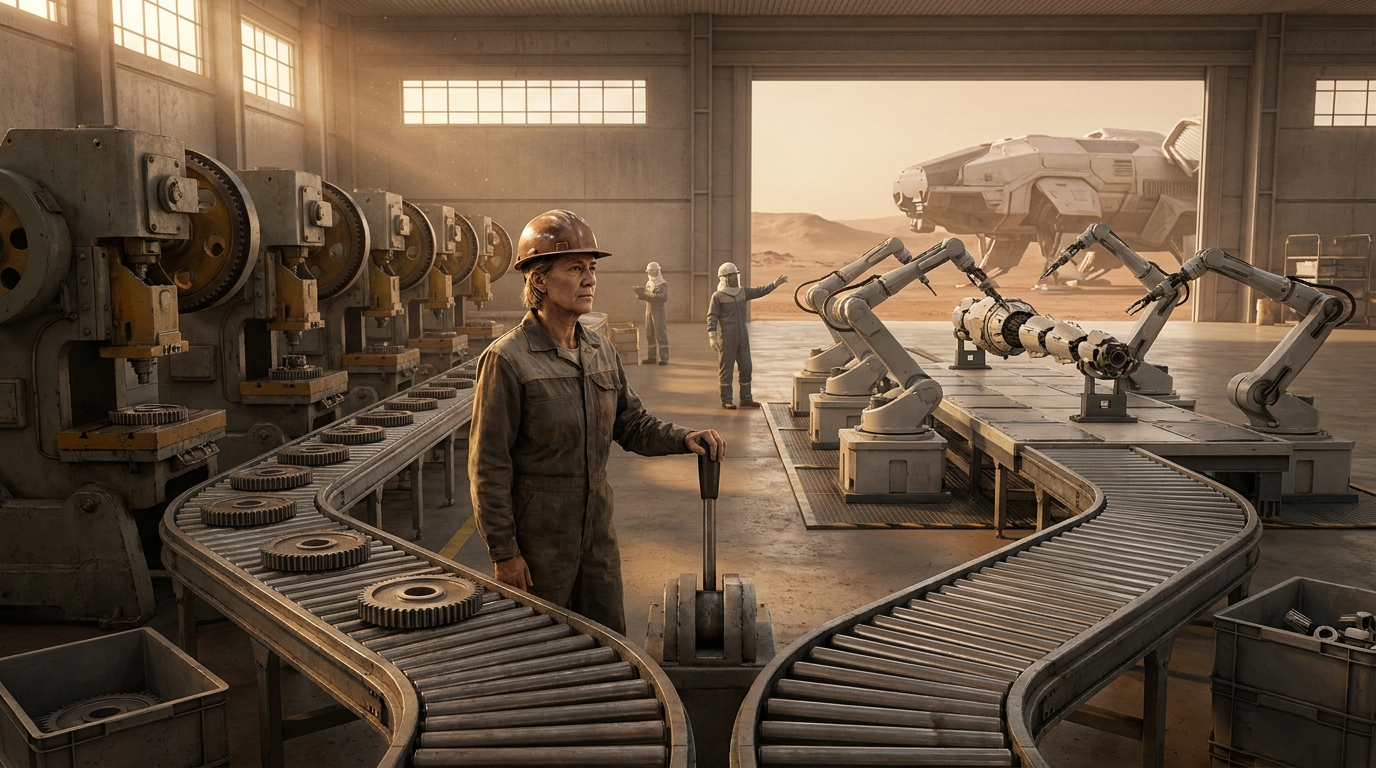
For the past few years, the public AI story has barely left the desk. Draft the email. Write the function. Summarise the deck. Generate the image. Meanwhile, a more consequential experiment has been moving through factories and logistics sites: models that can perceive a workspace, plan a task, and control a machine inside it.
The distinction matters. Software that produces a cheaper memo may trim an expense. Software that helps a robot switch tasks can change the capacity of a plant.
Today's systems do not amount to a general-purpose robot workforce, and most humanoid projects remain pilots. Factories are hostile to loose claims. A machine has to survive dust, variation, awkward objects, safety rules, and thousands of repetitions. A good demo proves very little about a twelve-hour shift.
Industrial automation has traditionally bound a machine to a narrow job. AI-driven robotics is beginning to loosen that bond. As equipment becomes more adaptable, physical capacity starts to inherit one of software's defining properties: it can improve after installation.
The machine is no longer finished at purchase
Old industrial robots are remarkably good at repetition. Put an arm inside a controlled cell, give it a stable object and a fixed path, and it can perform the same movement with speed and precision for years. That strength is also the constraint. Change the product, packaging, input position, or surrounding process and the cell may need new tooling, new programming, or a full redesign.
The IIoT World 2026 Smart Factory Outlook describes the move from single-task, hard-coded machines towards systems that use AI to respond to changing conditions. The useful advance is equipment that handles more variation without engineers rebuilding the environment around it every time demand changes, rather than a robot shaped like a person.
That turns a capital purchase into a continuing software project. The frame, motors, grippers, cameras, and safety systems still matter. They wear out and impose hard limits. But more of the machine's economic value now sits in perception, planning, task libraries, monitoring, and updates. A manufacturer may buy the hardware once and improve parts of its behaviour many times.
This shifts production changes from a retooling problem to a software-and-integration problem. It does not make factories as frictionless as cloud software; atoms remain stubborn. But it reduces the cost and time required to repurpose a line, especially where products change frequently or inputs arrive in inconsistent forms.
Enterprise spending is following that practical test. McKinsey's State of AI in 2026 focuses on the move from experiments towards measurable returns. In manufacturing and supply chains, that pushes attention towards metrics operators already understand: throughput, downtime, intervention rate, defects, and cost per completed task.
A factory manager does not need a robot to be intelligent in the abstract. The manager needs it to clear a machine safely, move the right component, detect a bad part, or keep a process running when a shift is understaffed.
Humanoids face an unglamorous test
Humanoid robots attract attention because factories, warehouses, and tools were built around the human body. Doors, stairs, shelves, handles, workstations, and aisle widths already assume a worker with two arms and two legs. In theory, a general-purpose body can enter those facilities without the expensive reconstruction demanded by fixed automation.
In practice, the body shape settles nothing. The hard questions are reliability, safety, speed, supervision, and economics. Can the robot perform useful work for long enough between interventions? Can it recover when a part is misplaced? Can people share the space with it? Does the completed-task cost beat an ordinary machine, a redesigned process, or a person?
The manufacturing tracker There's A Robot For That reports real deployments and pilots in tasks such as parts kitting, machine tending, quality inspection, and material movement. A tracker is not audited industry-wide data, and vendor announcements still warrant scepticism. Even so, these examples reveal where the technology is being tested: repetitive work in existing facilities where rebuilding the whole line may be impractical.
The most credible deployments are boring. They give humanoids bounded tasks, known work areas, clear escalation paths, and measurable targets instead of demanding human-level versatility. Operators can then assess the system like any other piece of production infrastructure: uptime, mean time to intervention, throughput per shift, and cost per successful task.
That operating discipline is more valuable than a dazzling demo. A company that buys a robot without building the surrounding process has purchased an expensive source of exceptions. Someone still has to define the task, supply training data, connect the robot to production systems, monitor failures, manage updates, and decide when a human takes over. The robot may be general-purpose; the deployment never is.
A new operating model for industrial companies
If adaptable robotics keeps improving, companies will feel the effects far beyond the automation budget.
Procurement changes first. Buyers will need to judge the software roadmap, update policy, data rights, integration layer, and vendor survival risk alongside payload, reach, and service life. A mechanically sound robot tied to weak software may age faster than its depreciation schedule suggests. A capable platform with regular updates may become more useful after purchase, although no CFO should price that possibility into a business case without evidence.
Factory design changes too. Flexible systems could make smaller production runs and brownfield sites easier to automate because companies would need fewer task-specific cells. That does not guarantee a wave of reshoring or local micro-factories. Energy, logistics, regulation, suppliers, and labour costs still govern location decisions. But adaptable machines alter one variable that has kept automation concentrated in large, stable, high-volume plants: the cost of changing what a site produces.
The biggest advantage may belong to companies that learn fastest on the factory floor. Each deployment can produce task data, failure cases, recovery procedures, and integration knowledge. That operational learning is difficult to buy later because much of it belongs to a particular plant, product, and process. Two companies can purchase the same robot and get very different results.
Robotics can add capacity where labour is scarce, keep older facilities useful, make shorter production runs easier to justify, and move people away from hazardous tasks. None of those gains arrives automatically, and none requires a fantasy of labour disappearing.
The companies worth watching are already doing the dull work: choosing bounded tasks, measuring interventions, redesigning workflows, and teaching operations teams to manage machines whose behaviour can change with an update. Over the next few years, their advantage will show up in ordinary industrial numbers: more output from constrained sites, faster product changeovers, fewer stalled shifts, and better returns on equipment already bolted to the floor.