Blog
The Three-Person Company With a Fleet
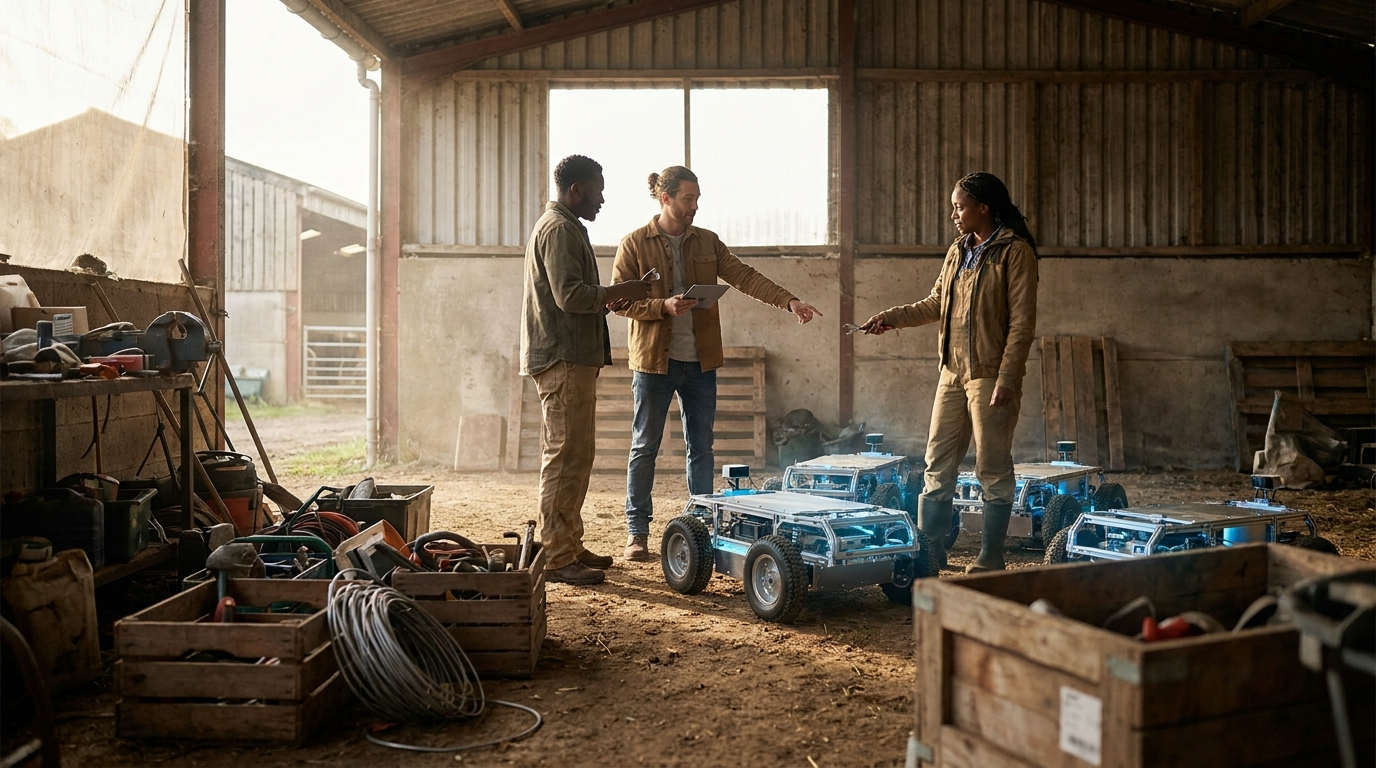
Imagine a three-person product company on a Monday morning. One founder is tweaking a CAD drawing. Another is on the phone with a supplier. The third is checking a queue of work completed overnight: customer replies drafted, product descriptions translated, inventory exceptions flagged, and a new production run staged for review.
On the workshop floor, a collaborative robot handles one repetitive packing step. A person loads the awkward parts, inspects the finish, and deals with anything that looks off.
None of this requires a science-fiction breakthrough. You can assemble the software from current foundation models, standard ecommerce APIs, and workflow automation. The cobots already exist and sell off the shelf. The hard part is deciding where automation belongs, setting hard boundaries, and verifying that the output is actually good enough to ship.
That changes what a small company can attempt. A team no longer has to hire for every repeated task before it can increase output. It can add software and machines first, then hire where human judgement, relationships, or craft remain the bottleneck.
Execution is getting cheaper
The macroeconomic forecasts are enormous, but the useful signal is buried inside them. Goldman Sachs estimates that widespread generative AI adoption could lift annual labour-productivity growth by around 1.5 percentage points over a ten-year period. Its analysis also notes that most occupations are partly exposed to automation, rather than fully replaceable.
That distinction matters. Partial exposure means a company can automate slices of a job without pretending it has automated the whole role. A customer-support agent can draft routine replies while a person handles refunds, angry customers, and odd edge cases. A coding agent can prepare a pull request while an engineer owns the architecture and decides whether the code should reach production. The saving comes from removing repeated execution, not deleting human responsibility.
McKinsey's analysis points in the same direction. It estimates that about 75 percent of generative AI's potential value sits in customer operations, marketing and sales, software engineering, and R&D. These are broad categories, but much of the daily work inside them can be described, queued, checked, and repeated.
Physical automation is moving along a similar curve. The International Federation of Robotics continues to report industrial robot installations at historically high levels and tracks the steady spread of collaborative robots. Cobots matter to small companies because they are designed to work safely alongside people and can be reprogrammed for different tasks without a team of systems integrators. They do not turn a workshop into a dark factory. They make one boring, consistent physical motion available on demand.
Software agents and cobots are very different technologies, but they hit the same line in a company budget: execution can be bought as modular systems rather than added as permanent payroll and organisational weight.
Growing without growing everywhere
The old route from a promising prototype to a serious business required a familiar pile of headcount. More orders meant more customer service reps, more coordination overhead, more floor labour, more marketing staff, and more managers to keep those groups aligned. Hiring was the only practical way through each operational bottleneck.
A small team now has another option. It can build a narrow operating layer around the founders. Agents can sort inbound tickets, draft routine communications, compare supplier quotes, prepare campaign variants, and turn a specification into a first pass at code. Cobots can take selected workshop steps where the task is repetitive and the environment is controlled. People approve, repair, negotiate, and make the calls that depend on context.
I think of this as the three-person company with a fleet. The fleet is mostly software, with physical machines where the economics make sense. It does not run itself. Someone has to define each job, grant the right permissions, monitor failure rates, and stop a bad run before it reaches customers. In practice, one of the three founders may spend a surprising amount of time doing exactly that.
That role is easy to underestimate. A fleet creates queues, access permissions, logs, maintenance, and exceptions. If five agents can act on the same customer record, somebody needs to decide which one is allowed to send an email, issue a refund, or update stock levels. If a cobot repeats a bad toolpath with perfect precision, somebody still owns the scrapped batch.
So the smaller company does not become a miniature version of a large enterprise. Its shape is fundamentally different. It has fewer handoffs between departments and more handoffs between people and systems. It hires later for routine volume, but earlier for judgement, systems integration, and quality control. The advantage comes from short feedback loops: spot a problem, adjust the workflow prompt or fixture, test it, and keep or scrap the change.
This model also widens the range of viable businesses. Products with modest niche demand can support a small team even when they could never sustain a conventional organisation. A specialist manufacturer can sell internationally without building a multilingual support department first. A tiny software team can maintain more integrations than its headcount would once have allowed. These are possibilities, not guarantees. Distribution, unit economics, compliance, and customer trust still dictate whether the business survives.
Build the fleet one bottleneck at a time
The obvious mistake is to collect tools before finding work for them. A dashboard full of agents quickly turns into another system to supervise. A cobot can spend most of its life gathering dust if the task changes too often or the tooling setup takes longer than the job.
Start with one repeated bottleneck. Pick work that consumes measurable hours, follows a stable pattern, and can be checked before it causes damage. Drafting routine support replies is a better first agent job than issuing refunds. Moving identical parts between two fixed positions is a better first robot job than handling arbitrary objects in a cluttered workshop.
Keep the test simple. Record the hours spent before automation. Run the new workflow for a few weeks. Count the corrections, failures, and hours of supervision. Factor in setup and maintenance, because free execution that needs constant babysitting is just expensive execution with better branding.
If the numbers work, keep it and move to the next bottleneck. If they do not, rip it out. The goal is not to show off a large fleet. The goal is to give a small group enough dependable capacity to build, sell, and support something useful.
Thousands of small teams doing this quietly will reshape the broader economy. Each one adds output without adding matching organizational bloat. The practical question for a builder is straightforward: which repeated task can you hand to a system this month, with a verified check before the result reaches a customer?