Blog
The Workday Is Turning Into a Control Room
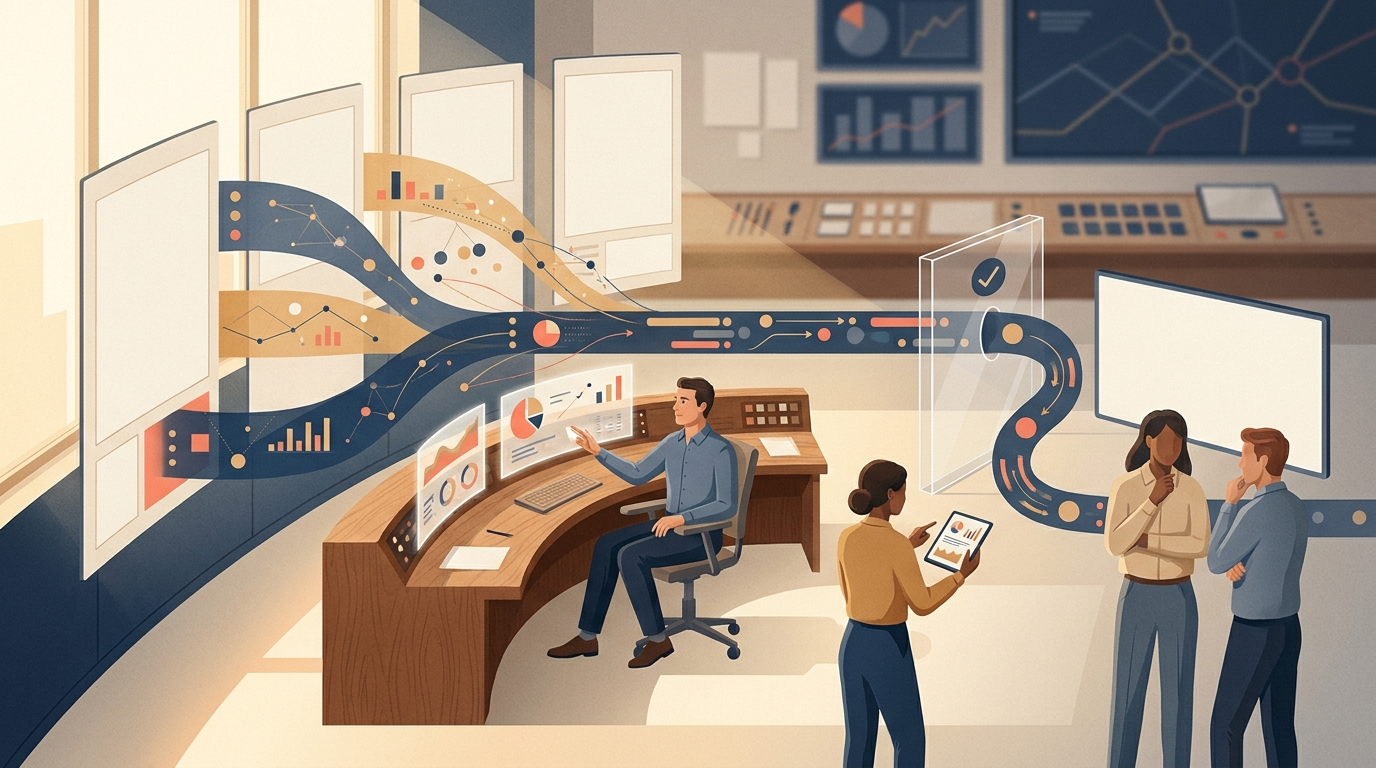
A three-person analytics team at Bolt.new built an agent that reads data across the company’s systems. According to the company’s CEO, the agent saves 12 to 13 hours of manual work each week, with output comparable to a 30-to-40-person team. It is also a job-design story.
The team kept its jobs while the work moved upward. People spend more time deciding which questions matter, checking whether the answers hold up, and choosing what should happen next.
That is the early shape of the AI workplace. The biggest change arrives inside the job before it appears in the employment statistics.
The job count is the wrong dashboard
The current labour-market debate keeps waiting for one dramatic number: how many jobs did AI erase? The number matters, but it is a slow instrument for a fast operational change.
The Guardian’s August 12 report found that the predicted wave of mass displacement has not appeared. It cited Stanford Institute for Economic Policy Research analysis showing that, since ChatGPT launched in 2022, unemployment among workers in the 20% of occupations most exposed to AI rose 0.77 percentage points. The least-exposed group saw a 0.85 percentage-point rise over the same period.
The data corrects the loudest predictions while the workplace keeps moving.
The same Guardian report cites ZipRecruiter data showing that about 74% of employers see AI skills as a strong advantage or requirement. Thirteen percent require them across the company, rather than in technical roles alone. Half expect candidates to arrive with practical or advanced AI skills on day one.
The bar is rising inside existing roles. A customer-support lead may need to review an assistant’s escalation queue. A marketer may approve a research agent’s sources before a campaign moves. An operations manager may set the boundaries for an assistant that touches stock, invoices, or schedules.
The title can stay the same while the daily control surface changes.
Reuters made the timing point in a 13 August analysis: AI is showing up in markets, construction, and corporate planning, but its footprint in the jobs and inflation data watched by the Federal Reserve remains small and contradictory. A company can reorganise a workflow this morning and leave no clean trace in a national jobs report for years.
That delay creates a dangerous reporting gap. Leaders can feel the productivity gain before they know whether the new process is improving the work or only moving the burden onto fewer people.
The control room arrives inside the job
An assistant changes a job when it can carry a task across several steps without waiting for a person to type every instruction. The human role then becomes a sequence of decisions: define the outcome, hand over the right context, inspect the result, resolve the exception, and update the process when the same exception appears twice.
This is more concrete than calling someone an “AI supervisor”. The supervisor needs a working queue, an evidence trail, and a clear boundary around what the assistant may do without approval.
The analytics team at Bolt.new is a clean example. The agent handles the searching and first-pass analysis. The people decide which questions deserve time. Their value shifts from retrieving every answer to selecting the questions that change a decision. That is a better use of scarce human attention, provided the team can see how the agent reached its result.
The same pattern applies outside analytics. An HR assistant can collect candidate information, compare it with a role rubric, and flag missing evidence. A human still decides whether the rubric is fair and whether the candidate should move forward. A purchasing assistant can monitor prices and prepare an order. Someone still sets the spending limit and approves an unusual supplier.
The practical skill is process design. Workers need to know where an assistant can act, where it must pause, what evidence counts as a completed step, and how to undo a bad handoff. Companies that treat the assistant as a chat window will get scattered bursts of speed. Companies that treat it as a worker inside a queue can measure the result.
That difference explains why the job shift can feel confusing. One person may produce far more verified work, while another spends half the day moving context between five tools. Both can say they are using AI. Only one has redesigned the workflow.
The new work has a tax and a payoff
Research reported by The Manila Times gives the failure mode a useful name: the “Toggle Tax”. HERE Enterprise found that three in ten professionals spend at least half their workday copying information between AI and other systems. Among respondents who said AI worsened their overall work experience, 66% reported more mental fatigue or emotional burnout. Forty-five percent said they spent more time managing AI than doing their core responsibilities.
The fix sits in the architecture. An assistant cannot improve a workflow if the worker must keep rebuilding the workflow around it.
A good control room keeps the task, context, permissions, evidence, and next action close together. It tells the worker what the assistant did, what it could not verify, and what needs a decision. The interface can be plain. The handoffs cannot be vague.
This is also where the risk becomes uneven. The Guardian’s recent opinion column on AI, inequality, and rogue agents is right to focus attention on job quality and power, even though it is an opinion piece rather than neutral labour-market evidence. A faster workflow can give a skilled worker more room to think. It can also make a junior worker responsible for cleaning up machine decisions without giving them authority, training, or a career ladder.
The answer is visible in the workflow design. Give assistants narrow permissions first. Log the inputs and outputs. Make a human approval explicit when the cost of an error is high. Measure time to a verified result, not the number of AI actions. If the queue gets faster while the exception rate and worker fatigue rise, the system is failing.
The optimistic case is still strong. A person who can direct several reliable work streams can spend more of the day on questions, relationships, experiments, and decisions that used to be squeezed between administrative chores. That capacity appears when the assistant is attached to a real workflow. The Bolt.new example shows what this looks like in practice.
The workday is becoming a control room because assistants are taking over more of the movement between steps. The people who benefit most will learn to design those steps, inspect the evidence, and keep the machine inside a useful boundary. Start with one queue, one measurable outcome, and one approval rule. Then see what the job becomes when the routine work stops blocking the interesting work.