Blog
The Future of Work Is Starting to Look Like Agent Supervision
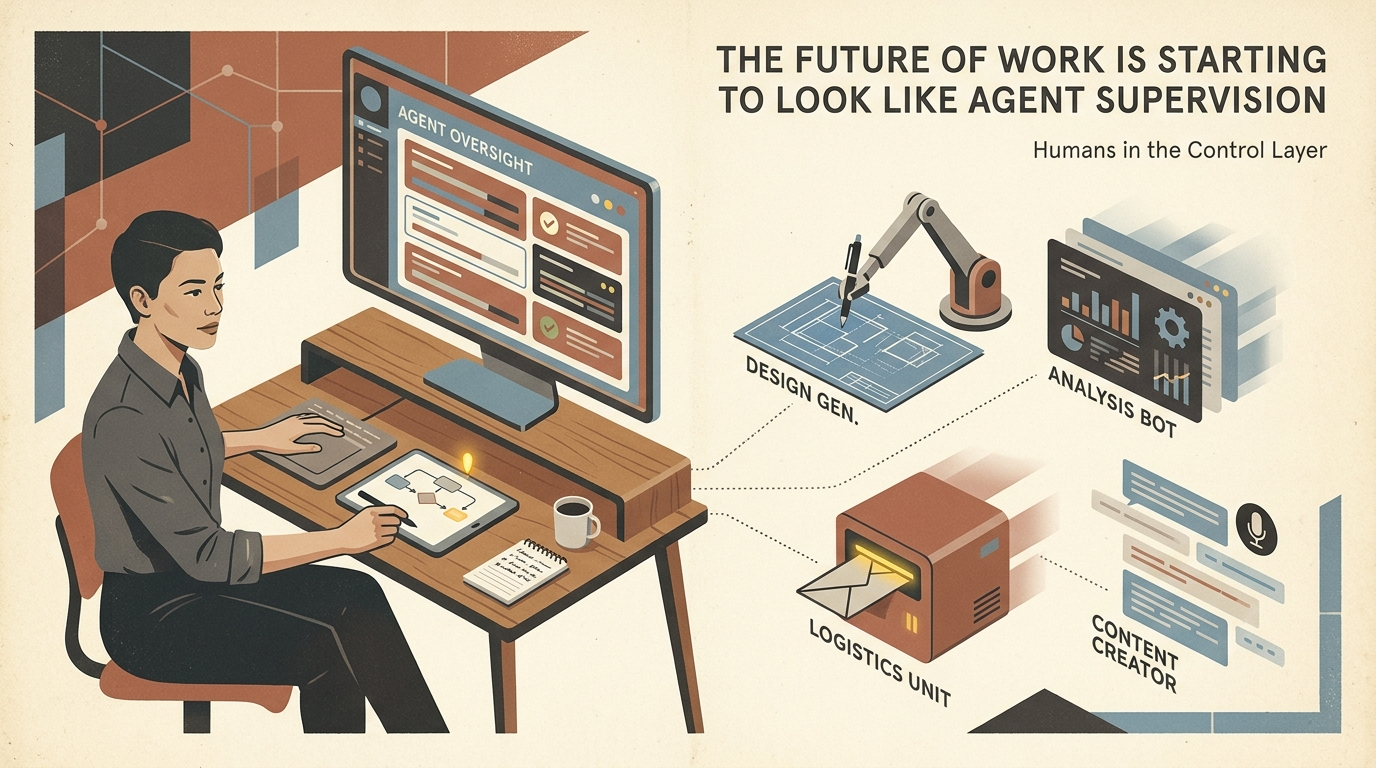
The lazy version of the future-of-work debate is still everywhere: either AI replaces everyone, or it changes nothing important and we all carry on with slightly better autocomplete.
That framing already feels stale.
What the last few days have made clearer is something more practical and more interesting. The shape of work is changing fastest in the layer above execution. The valuable move is becoming: define the task well, give the system the right context, keep the boundaries tight, and verify what comes back.
That is not theory anymore. It is visible in the products shipping right now.
When OpenAI’s recent ChatGPT release notes talk about scheduled tasks, remote access, and richer business workflows, they are not describing a chatbot that answers questions a bit faster. They are describing software that increasingly sits inside the flow of work and carries tasks forward over time. When GitHub’s new Copilot app presents the desktop as a control center for multiple agent sessions, separate worktrees, plans, and outputs, it is making the same point from the engineering side. The job is shifting from pure production toward orchestration.
That word matters, because it is a better guide to what teams should actually prepare for.
The job is moving up a layer
A lot of knowledge work used to be bottlenecked by manual execution. Writing the first draft. Gathering the references. Spinning up the test harness. Checking the APIs. Preparing the comparison table. Creating the variant. Following the procedure step by step.
AI systems are getting good enough at those moves that the scarce skill is starting to migrate. The hard part is less often “can the system do a first pass?” and more often “did we define the assignment properly, give it the right context, constrain the environment, and catch the bad output before it spreads?”
You can see this in the kinds of products being launched.
Postman’s AI Engineer is not framed as a magic coding trick. It is framed around the broader operating surface of real work: exploring APIs, understanding systems, assisting with QA, tracing issues, and helping teams reason through technical environments that are too large to hold cleanly in one person’s head. Microsoft’s Build 2026 framing leans in the same direction. The message is not “AI writes everything now.” The message is that useful AI at work needs context, policy, identity, security, and human judgment wrapped around it.
That is why the hot job title in a few years may not be “prompt engineer,” but something much more ordinary and much more durable: manager, operator, editor, analyst, engineer, founder, designer, or team lead — except each of those roles is now expected to coordinate a growing layer of machine execution.
The winners will be the people who can direct systems, not just use tools
This is where a lot of people still underestimate the shift.
Using AI well is not mainly about finding one clever prompt. It is about building a repeatable way to get reliable outcomes from semi-autonomous systems.
That means a few things start to matter a lot more:
context hygiene
clear task design
permission boundaries
source quality
verification discipline
knowing when to trust the draft and when to throw it away
The reason GitHub’s cloud and local sandboxes are important is not that sandboxes sound enterprise-friendly. It is that once agents can touch files, run commands, and make multi-step changes, bounded execution becomes part of the product, not a side detail. If the system can act, then safe work depends on supervision infrastructure.
That idea travels far beyond software engineering.
In recruiting, it means AI can screen, draft, summarize, and schedule, but humans still need to define quality, fairness, escalation rules, and final judgment. In finance, it means agents can prepare analysis, reconcile documents, and monitor workflows, while humans own risk thresholds, exceptions, and interpretation. In operations, it means more of the drudge work disappears, but more of the role becomes about designing and maintaining the machine-assisted process itself.
That is the deeper reason the future of work is not just a headcount question. It is a systems question.
Plenty of jobs will change before they disappear. Some job slices will get compressed hard. Some whole roles will get redefined. But the near-term pattern still looks more like restructuring than clean replacement. Even the louder macro commentary this week has been a reminder that the economy is entering an unstable transition, not a neat overnight swap of humans for models. The people who stay valuable will be the ones who can keep outcomes aligned while more of the underlying motion becomes automated.
A practical playbook for the next two years
If you run a company or lead a team, the useful question is not “which jobs does AI kill?” It is “which parts of each role can become agentic, and what new supervision work appears when they do?”
That usually leads to a better plan:
First, break work into execution, judgment, and accountability. Execution is the easiest layer to accelerate. Judgment is where context and taste matter. Accountability is where the human still has to own the decision.
Second, build workflows around reviewable outputs, not blind trust. If an agent drafts, researches, triages, or changes something, the result should be easy to inspect. Hidden autonomy is a bad operating model.
Third, upgrade your best people into system directors. Your strongest operators should not spend all day doing the steps manually if the steps can be delegated safely. They should be designing the workflow, tightening the feedback loop, and handling the exceptions that actually need brains.
Fourth, accept that software literacy is spreading into every role. You do not need every employee to become an engineer. You probably do need more employees who can specify intent clearly, evaluate outputs, and work comfortably with machine collaborators.
That is the future-of-work shift I believe is already underway.
Not fewer humans in the loop.
Humans moving to the control layer.
And for ambitious teams, that is a very good trade.