Blog
AI’s Next Killer Apps Are Hiding in Weird Workflows
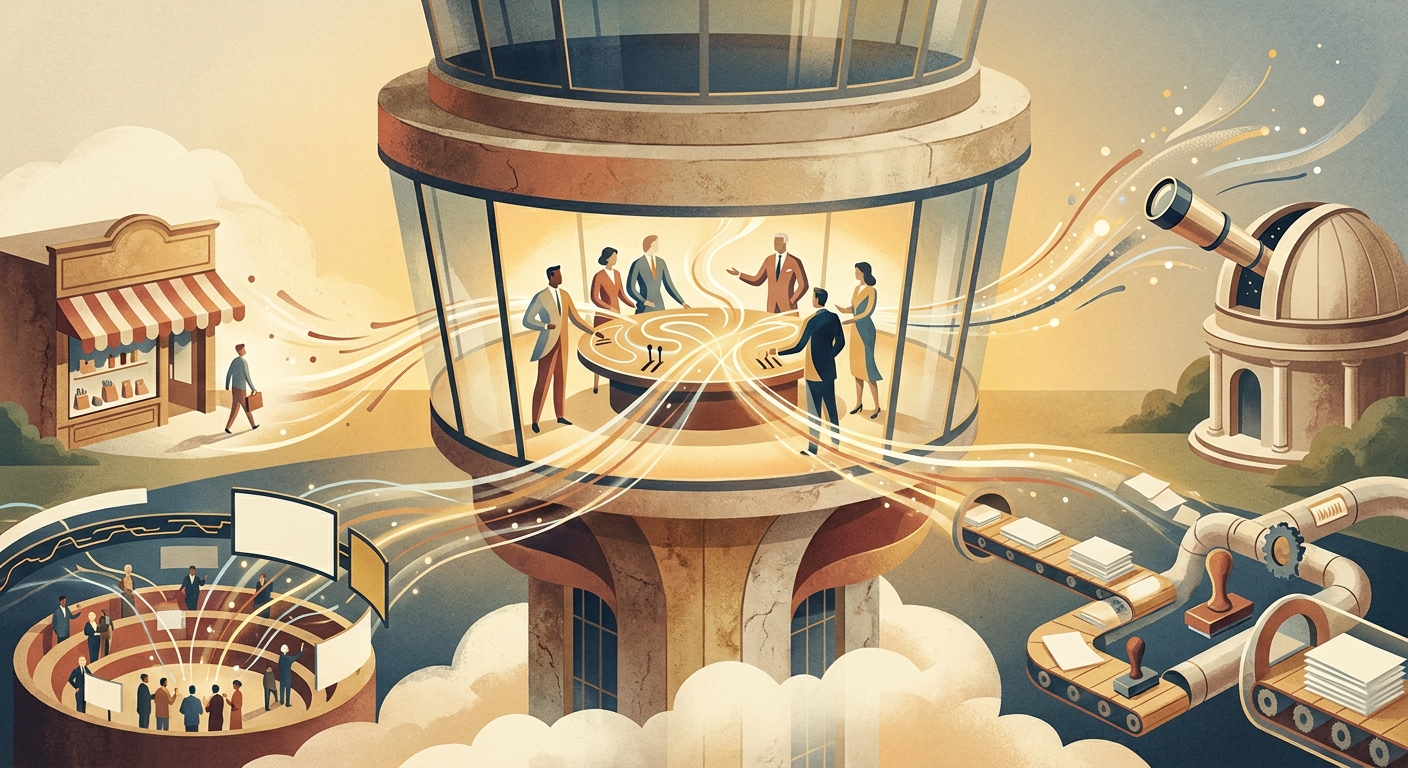
The most useful AI stories right now are not the broad “assistant for everything” pitches. They are the ones where AI gets dropped into a real job, a messy system, or a painfully slow process, and suddenly the whole workflow changes shape.
Over the last few days, that pattern has been everywhere. OpenAI’s new case study on LSEG describes AI helping compress product release cycles from three to six months down to two weeks, with customer delivery timelines landing around four weeks. Google’s latest Gemini business update pushes AI directly into the operating layer of small companies by connecting it to Google Business Profile and business notebooks. AWS’s medical, legal, and regulatory review orchestration post shows multiple specialized agents reviewing regulated content against literature, policies, and approved claims. And OpenAI’s profile of astrophysicist Oliver Hahn using Codex to help simulate black holes is a reminder that frontier use cases are already escaping the office and landing in scientific computation.
That is a much more interesting story than “AI writes emails faster.”
The pattern hiding in plain sight
If you line these examples up, the pattern becomes obvious: the best new AI use cases are not generic. They are context-heavy.
LSEG is not using models as a novelty layer. It is wiring them into a system where speed matters, domain language matters, trust matters, and mistakes cost real money. The gain is not that somebody gets prettier summaries. The gain is that institutional knowledge becomes easier to interrogate, decisions move faster, and product teams ship on a timeline that would have sounded unrealistic a year ago.
Google’s Gemini move matters for the same reason. A small business owner does not need abstract “AI productivity.” They need help answering reviews, understanding performance, planning customer communication, and making sense of the operational residue sitting inside their existing tools. Once AI has access to that local context, it stops being a toy and starts behaving more like leverage.
AWS is pointing at a third category that will get very big: regulated coordination. Medical, legal, and regulatory review is exactly the kind of workflow people used to assume AI could not touch because the stakes are too high and the source material is too fragmented. But that assumption only holds if you imagine one model improvising in a vacuum. The moment you design a system around multiple agents, constrained tasks, source grounding, and explicit review paths, the economics change.
And then there is the black hole example. I love that one because it blows up the lazy idea that AI use cases peak at marketing copy and software boilerplate. In Hahn’s workflow, the model is not replacing physics. It is helping generate and test candidate numerical approaches in a domain where verification is ruthless. That is exactly what you want from a powerful tool: more search over good possibilities, faster iteration, and tighter human judgment at the point where truth actually matters.
Why the weird workflows win first
The next breakout AI products are going to look strangely specific before they look inevitable.
That is normal.
A broad chat interface is a great distribution wedge, but it is usually not the end-state product. The end-state product is the system that knows where the data lives, understands the task sequence, keeps working over time, and can be checked against reality.
That is also why OpenAI’s planned acquisition of Ona is worth paying attention to. The interesting signal is not corporate M&A gossip. The signal is architectural. Persistent, secure execution environments are becoming part of the stack for serious agentic work. If the model can keep context, operate across tools, and run inside a controlled environment, the set of viable use cases expands fast.
This is where a lot of builders still get tripped up. They are looking for one universal killer app when the better lens is a thousand narrow doors. Every industry has workflows that are too slow, too manual, too fragmented, too dependent on tribal knowledge, or too annoying for humans to do consistently well. AI does not need to “solve intelligence” to attack those workflows. It needs enough context, enough memory, enough tool access, and enough verification to become dependable inside the loop.
That combination is what turns “unexpected use case” into “obvious new product category.”
A practical filter for spotting the next wave
If you are building in AI, here is the simplest filter I know right now.
Look for workflows with four traits:
High context load. The job depends on documents, prior decisions, edge cases, internal language, or account history.
Expensive latency. Delays cost money, customer trust, or missed opportunity.
Checkable outputs. There is some form of ground truth, approval path, or observable result.
Messy coordination. The pain is not one task. It is the handoff between tasks, people, and systems.
That is why finance, compliance, operations, research, and small-business tooling are suddenly so fertile. They have all four.
The same logic will spill into private life too, although probably through quieter doors first: household logistics, insurance claims, healthcare paperwork, school coordination, personal finance cleanup, travel recovery, family scheduling. Not because consumers want “more AI,” but because they want less drag. The winning products will feel less like chatting with a machine and more like recovering hours of life that used to dissolve into admin.
That is the real tell. When AI use cases stop looking performative and start looking like invisible throughput, you are close to a durable market.
The next killer app probably will not announce itself with a flashy demo. It will show up as a workflow that suddenly feels unfairly fast.
And once people taste that, they do not go back.