Blog
August 2026 Was the Month AI Started Moving to Orbit
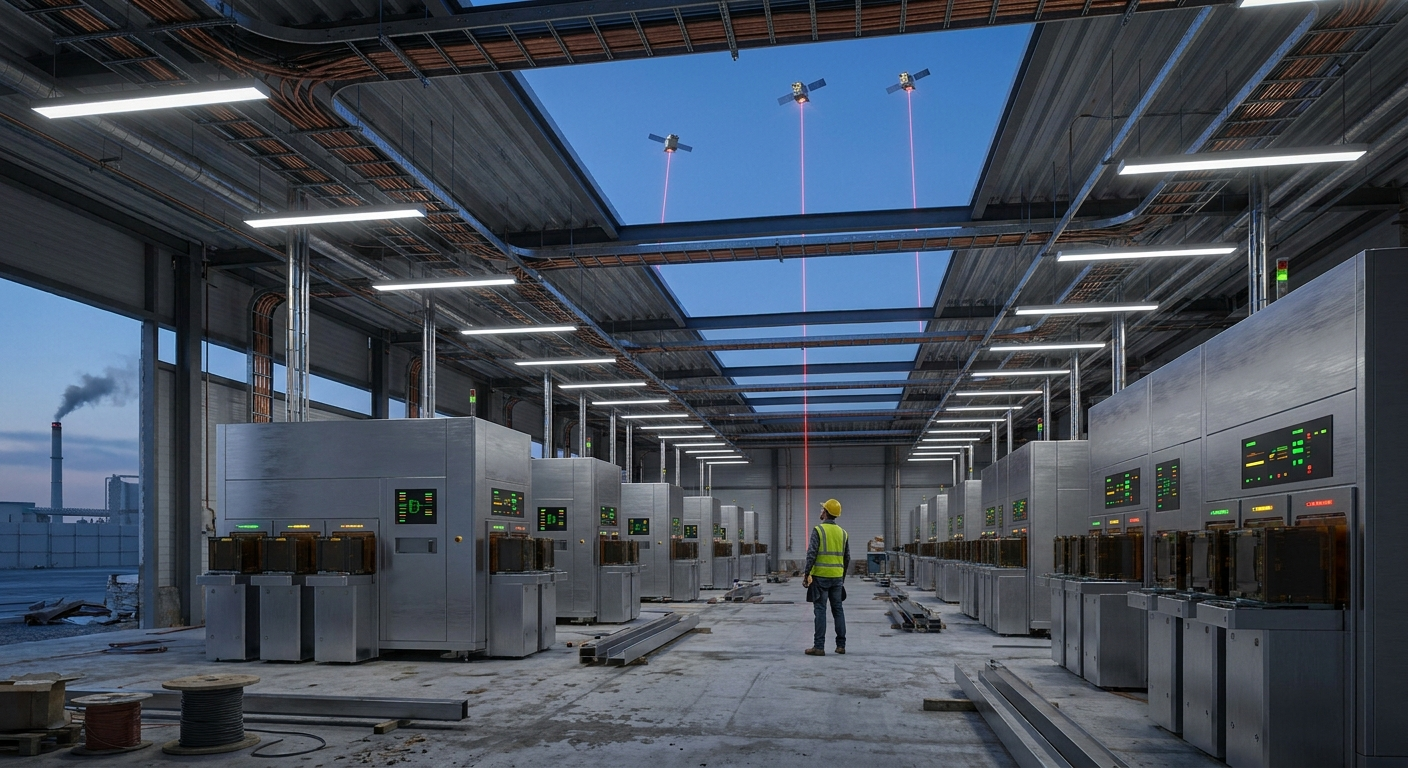
Why terrestrial AI infrastructure is hitting the wall
On August 4, Elon Musk posted a video making a specific claim: within 36 months, the cheapest place to put AI compute will be in space. Two days later, SpaceX and Tesla publicly launched Terafab, a 100 million square foot chip factory explicitly designed for "Earth and orbit," with a stated target of one terawatt of solar-powered compute per year and ten million tons of mass to orbit annually. On August 5, The Register reported that Starlink revenue is now subsidizing the xAI cash burn, and Reuters confirmed the same pattern from the other direction. Same week.
The 2026 version is sharper. Terrestrial AI infrastructure has begun to fail, and the orbital alternative has stopped being hypothetical. That shift explains why a chip factory announcement in Austin and a 36-month timeline on a YouTube video landed in the same news cycle.
The constraint is no longer compute. It is the surrounding box.
Look at the xAI Colossus data center in Memphis, brought online in 122 days from groundbreak to operation in 2024. The site ran 69 unpermitted gas turbines for two years before reaching a remediation deal with the Mississippi Department of Environmental Quality in late July 2026. The deal pushes full turbine removal to July 2027. Southern Environmental Law Center sued on Clean Air Act grounds on behalf of the NAACP. The Department of Justice pushed the court to dismiss the case on national security grounds. The turbines keep running. The 10 to 15 data centers now ringing Memphis are concentrated in majority-Black neighborhoods that have been redlined into industrial zones for decades. Sonic pollution below 20 Hz is implicated in reported migraine, nausea, and sleep disruption up to several miles out. That is a single site. Scale it across Virginia's data center alley, the Phoenix exurbs, the Dublin server farms: the limit on AI capacity expansion is now environmental permitting, grid interconnect queues, water access for cooling, and community litigation. Not flops.
The numbers are blunt. Virginia's Dominion Energy interconnection queue had more than 30 GW of data center requests pending as of mid-2026. Phoenix's utility rejected new large-load applications in late 2025 because the grid could not support them. Dublin's Uisce Éireann constrained new connections for the same cooling-water reason. Each of those is a wall, not a ramp.
So the orbital compute thesis that TechCrunch flagged in April when the first commercial orbital cluster came online, and that SpaceX's IPO deck put into a public filing in June with the exact phrase "Deploy orbital AI compute at scale," has acquired a near-term business reason. The walls on Earth are real and growing faster than the chips are getting cheaper.
What "orbital compute" actually means now
Terafab is the first factory plan attached to that thesis. Read the Terafab page carefully and the specific claims stand out. The factory combines logic, memory, and advanced packaging under one roof. Current advanced packaging is split across Taiwan, South Korea, and Arizona, so collapsing it is a real manufacturing bet, not a marketing line. The 1 TW per year target is roughly four times current US electricity consumption, which is the part that reads as sci-fi until you notice the planned mass-to-orbit cadence: 10 million tons per year, 100× the current global launch cadence.
The technical objections are real and worth naming. Radiation is the first one. The consensus a year ago was that orbital compute needed rad-hardened chips, which cost 10× to 100× commercial silicon and lag it by a generation. Vincent Pribble's Substack piece from July argues the right answer is COTS silicon with software mitigation, and his evidence is that the largest orbital cluster currently in production runs commercial GPUs with checkpoint-restart at known radiation thresholds. That is the path Terafab's AI5 and AI6 chips are designed for. COTS + software is cheaper and faster than rad-hard, and the recent cluster data is the proof point.
Scheduling itself is the second objection. Orbits are not interchangeable with cloud regions. A satellite in a useful orbit passes a given ground station for 12 minutes per pass. Compute jobs have to be scheduled around orbital mechanics, not the other way around. Rotastellar shipped the first API for that in March 2026. If you want to know whether a job ran at all, you query the orbital scheduler, not a status page.
The third objection is the launch cadence, which is the one Musk's August 4 timeline is most exposed to. Starship V3 has not yet flown at the mass-to-orbit rate Terafab assumes. The cadence gap is the variable that determines whether the August 6 announcement is a real factory or a press release.
What to watch next
Three concrete checkpoints land inside 18 months.
The first is the Starship V3 first orbital flight with a full payload bay. If it flies before Q2 2027 with the announced mass fraction, the 36-month Musk timeline starts to look defensible. If it slips past mid-2027, the timeline slips with it.
The second is the AI5 chip tape-out. Terafab's chips have to exist before the factory does. Tape-out milestones are public; watch the actual silicon, not the factory construction.
The third is the Memphis Colossus turbine removal date. The July 2027 deadline is the first regulatory forcing function on terrestrial AI infrastructure. If xAI misses it, the legal exposure for terrestrial AI buildouts gets measurable. If it hits it, every other operator inherits the same constraint and the orbital thesis gets a clock.
Terafab's announcement turns the thesis from a slide into a permitting question. The next 18 months decide whether it stays a slide or becomes a construction permit.