Blog
Robots Are Becoming Budget Lines, Not Experiments
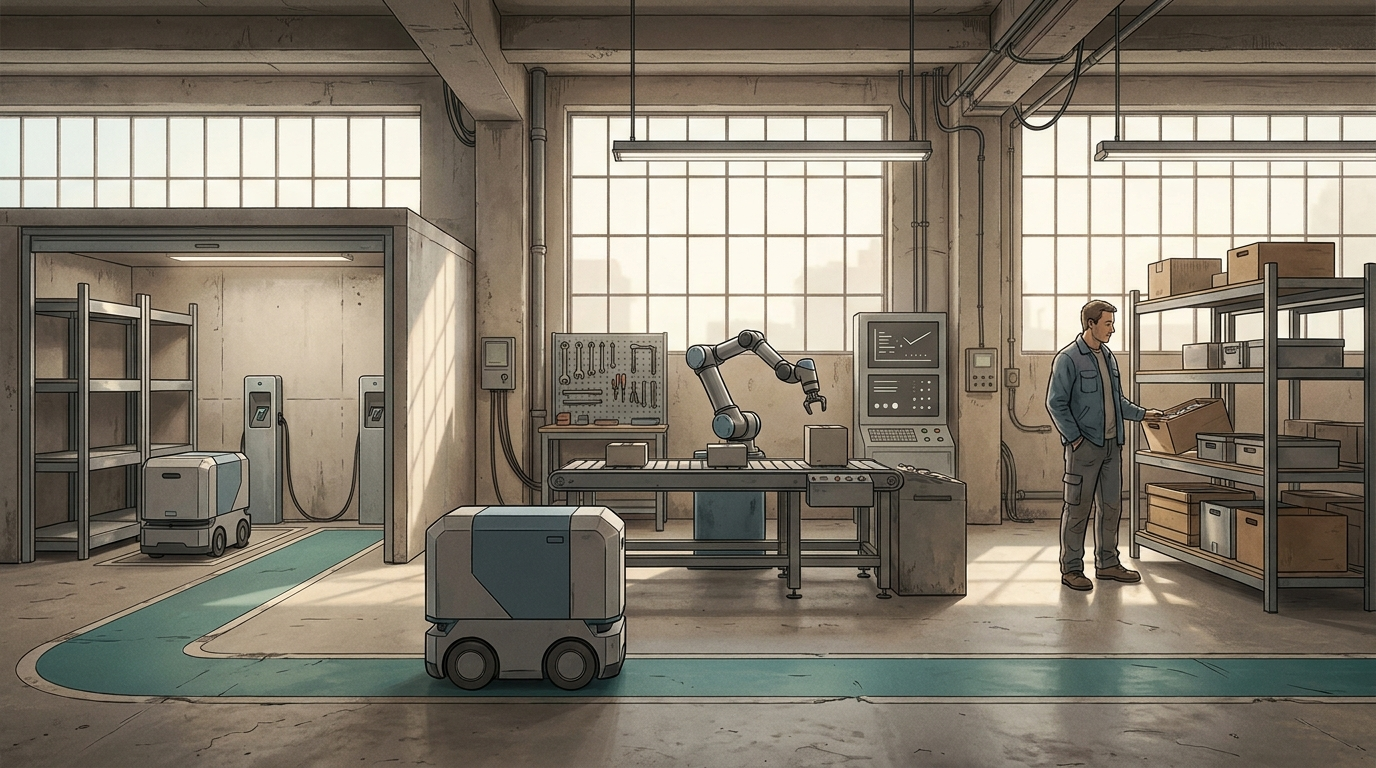
North American companies ordered $1.2 billion of robots in the first half of 2026. That is a 6.6% increase in spending year over year, according to A3 data reported by SupplyChainBrain. The unit count grew only 2%.
That mismatch suggests buyers are not rushing out to fill factories with generic machines. They are spending more deliberately on systems that fit a specific production or service problem.
For years, robotics sat in a strange corner of the company. The demo was impressive. The business case was foggy. A robot could sort, lift, inspect, or carry, but someone still had to explain which budget owned it, who trained around it, where it waited between jobs, and what happened when it stopped.
That is changing. The latest order data is less exciting than a video of a humanoid walking across a stage. It is also more important. Semiconductor and electronics orders rose 35% in the first half, pharmaceuticals rose 32%, automotive components 24%, and food and consumer goods 17%. Those sectors did not suddenly become fascinated by robot aesthetics. They have throughput constraints, safety requirements, staffing gaps, and expensive mistakes.
Robotics is starting to look like a line item because the work is becoming legible.
The first budget is for an ugly job
The useful robot story is rarely about replacing a whole role. It starts with a task that nobody wants to own: moving samples through a hospital, staging a delivery vehicle, carrying material between work cells, or getting an order from a restaurant kitchen to the street without another handoff.
The A3 figures make that point in a quiet way. Collaborative robots represented more than 15% of first-half orders. In pharmaceuticals, cobots made up 44% of orders. In semiconductors and electronics, they made up 37%. A cobot can enter an existing floor with less space and less fixed infrastructure than a traditional industrial machine. That matters when the job is narrow, the floor plan is cramped, and the owner needs the machine to earn its place quickly.
The purchase decision becomes easier when it is framed as a bottleneck removal project. A plant manager can see a queue that builds at one station. A hospital operations lead can count the walking time spent moving supplies. A restaurant group can see how long food waits after it is ready. Those are business problems before they are robotics problems.
That framing also puts pressure on robot companies. A machine that needs a custom integration team and a new operating model for every site will keep getting trapped in pilot purgatory. The winners will make deployment feel closer to adding a dependable piece of equipment than launching a research programme.
The network matters more than the robot demo
Serve Robotics and Grubhub announced a delivery partnership this week for Chicago, Los Angeles, and Alexandria. The release says the initial rollout covers more than 100 participating Grubhub merchants in Chicago and nearly 200 in Los Angeles. Serve also announced new markets in San Jose and Washington, DC, plus small Miami micro-depots for staging, charging, dispatch, and maintenance.
The partnership plugs robots into an existing marketplace. Grubhub already has merchants, customers, orders, and payment flows. A restaurant needs a pickup process that works when the machine arrives, a reliable handoff, and a way to see whether delivery time and cost improve.
Micro-depots determine whether a fleet can cover another neighbourhood without a costly new facility. Robots need somewhere to charge, wait, receive maintenance, and start a route. The physical support layer is easy to ignore in a product video, but it decides whether a fleet can expand.
The same pattern shows up in healthcare. Serve says its Moxi 2.0 hospital robot is rolling out at health systems including Endeavor Health Edward Hospital, Providence Saint John’s, and Children’s Hospital Los Angeles. Its stated improvements include faster perception, more onboard compute, and longer operation. Those are useful specifications. The operational question is simpler: which recurring trips can staff stop making, and can the machine complete them without creating more coordination work?
Every successful deployment has to answer that question in plain language. The robot is one component. The service model, dispatch system, facility layout, integrations, maintenance plan, and escalation path decide whether it becomes part of the operation or a costly isolated project.
The supply chain is becoming the product
CROB is a financial signal of the same shift. Defiance launched the ETF and describes it as the first US-listed fund dedicated to China’s humanoid robotics ecosystem. The fund tracks companies involved in motion control, precision actuators, sensors, automation equipment, and related supply-chain pieces.
An ETF launch does not prove that humanoid robots have solved commercial deployment. It does show where investors think the durable value may sit: in the industrial stack that makes a robot move, sense, and keep working at volume. That is a more grounded signal than a single glamorous prototype.
For companies considering robotics, the practical lesson is to begin with the operating boundary. Pick one repeatable task. Measure its current cost, delay, error rate, and safety burden. Then ask whether a robot can do that task inside the systems the business already trusts.
The best early projects will look almost boring. A machine takes the same route hundreds of times. A worker gets time back for a higher-value task. A queue shrinks. A site adds capacity without rebuilding the whole process. Finance can see the spend and the result in the same planning cycle.
That is how robots leave the innovation lab. They become budget lines when an operator can point to the work, the owner, the support model, and the number that improves.