Blog
The Patch Tuesday That Turned AI Into an Operations Problem
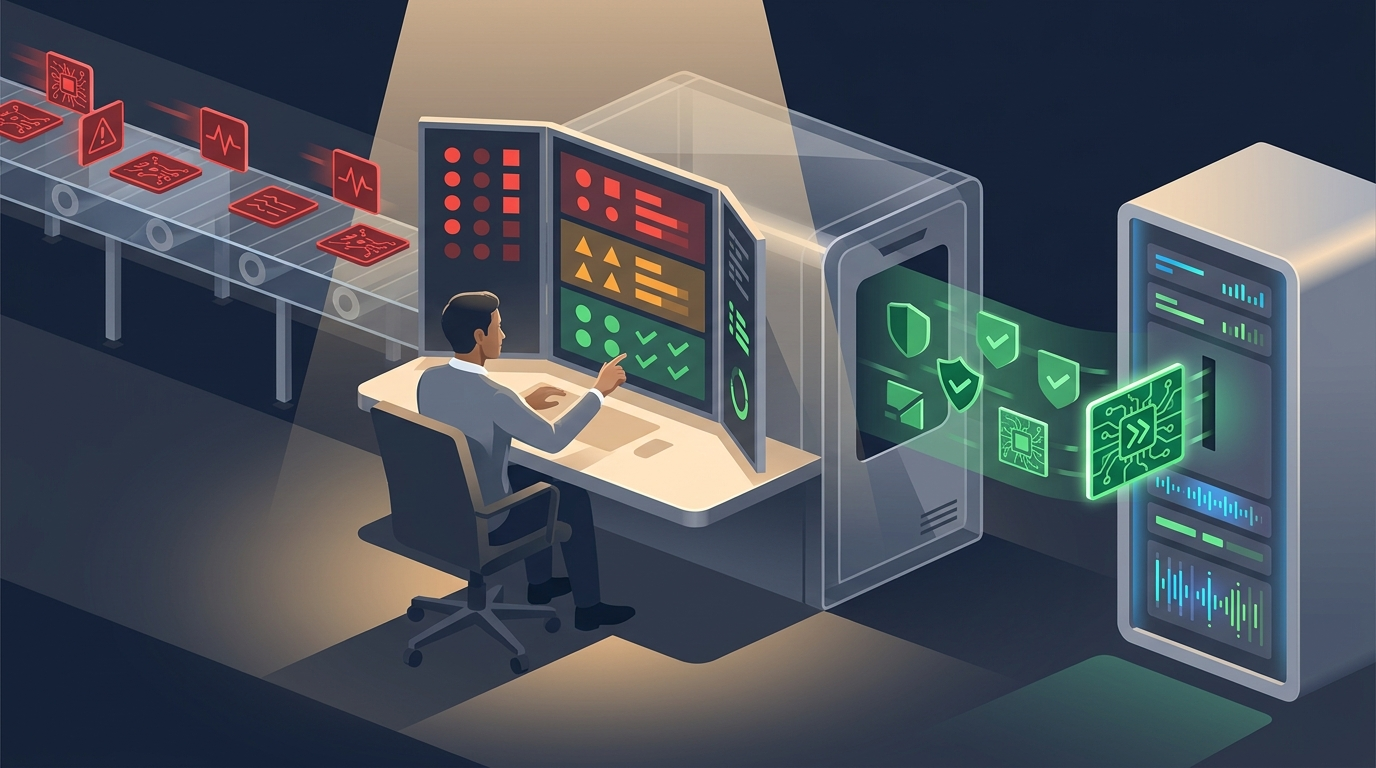
The number is hard to ignore: Microsoft’s July security release landed with a record-setting wave of fixes. Krebs on Security counted at least 570 security holes, including nearly 60 critical issues and three zero-days, two of which were already being exploited. Infosecurity Magazine reported the same 570-CVE Patch Tuesday and described the release as unprecedented.
The official Microsoft table is even broader. Microsoft’s Security Response Center lists 622 Microsoft CVEs across product families, including 416 Windows vulnerabilities. Those figures are not necessarily contradictory: the press reports are using the Patch Tuesday total, while Microsoft’s release note includes its wider CVE accounting and republishes hundreds of non-Microsoft Chromium CVEs.
Either way, the operational message is the same. The vulnerability queue is growing at machine speed.
The useful part of the scary number
The obvious reaction is alarm. A patch release this large sounds like a failure of software quality, a warning to shut down every system, or an excuse to wait until the dust settles. None of those reactions scales.
The more useful interpretation is that AI has changed the economics of finding defects. Microsoft has said its security teams are using AI to discover more issues across more code, faster. Infosecurity’s reporting quotes Bugcrowd’s Trey Ford describing the new volume as a fixed operating cost rather than a monthly surprise. Qualys researcher Mayuresh Dani points to automated fuzzing, LLM-assisted variant hunting, and static analysis as forces that are already finding bugs faster than enterprises can remediate them.
That is a meaningful technology milestone. It lives below the product-launch headlines, but it changes the shape of the work. A team can now receive a larger and more detailed map of its attack surface without having to wait for a human researcher to walk every path by hand. The benefit is better visibility. The cost is that visibility creates a queue.
A queue is a system-design problem.
The 570-CVE count also tells us why severity labels alone are not enough. Infosecurity broke the release down into 254 elevation-of-privilege flaws, 145 remote-code-execution bugs, and 102 information-disclosure vulnerabilities. Fifty-nine were rated critical, including 48 remote-code-execution issues. Those categories are useful, but they do not answer the question an operator actually faces at 09:00 on a Wednesday: which fix changes the risk of my environment today?
That answer depends on exposure, exploit evidence, asset importance, compensating controls, and the time required to recover if a patch misbehaves. The release note identifies exploited vulnerabilities in Active Directory Federation Services and SharePoint Server, while Krebs highlighted the way AI is also shrinking the time attackers need to turn known weaknesses into working exploits. A human-centred exploitability score ages badly when machines are doing the searching.
Patching needs a production pipeline
The practical response is to treat patching like a production workflow, not an inbox.
Start with an inventory that can answer three questions without a week-long audit: what do we run, where does it run, and who owns the decision to update it? If the inventory is incomplete, every prioritisation model is performing theatre. A critical fix on an unknown internet-facing appliance is not a low-priority ticket simply because the database does not know the appliance exists.
Next, separate intake from execution. New vulnerabilities should enter a queue with a risk score that combines technical severity, active exploitation, reachability, data sensitivity, and business importance. That queue needs an explicit service level. “We will patch it soon” is not an operating policy. “Internet-facing, exploited, and privileged systems get a tested change within 24 hours” is at least a policy someone can measure.
Then build staged rollout into the normal path. A small canary group should receive updates first, with health checks that are more meaningful than “the installer returned zero.” Test authentication, core workflows, monitoring, backups, integrations, and the specific workloads that make the business money. Keep a rollback plan that has been rehearsed while everyone is calm. The point is not to eliminate risk. The point is to keep a bad update from becoming a company-wide incident.
Microsoft’s release note also points to a concrete infrastructure response: its new Hotpatching feature is now generally available for Windows Server Azure Edition virtual machines. Hotpatching does not remove the need to test or understand updates, but it shows the direction of travel. The operating environment is being redesigned so that security maintenance can happen with less disruption to running services.
That is the pattern worth copying: make the safe action cheaper to perform.
Teams shipping AI-enabled products should extend the same pipeline to model-adjacent components. Patch the inference server, container base image, vector store, browser automation layer, identity provider, and observability stack. An application can have excellent prompt controls and still be exposed through an unpatched dependency that an agent can reach. The attack surface is the whole system that gives the model tools, data, and permissions.
The new baseline is readiness
The best teams will not win by reading the largest number of CVEs fastest. They will win by converting a high-volume feed into a predictable sequence of decisions.
That means maintaining a current asset graph, assigning owners before an incident, testing changes continuously, and measuring time from disclosure to verified remediation. It means reviewing whether an exploitability rating still reflects machine-assisted attackers. It means giving security engineers enough authority to pause a rollout and enough automation to resume it safely.
There is a bright side here. More defects found can mean fewer defects left quietly exploitable. AI-assisted discovery is valuable precisely because it exposes weaknesses that manual processes miss. But the gain only becomes real when the rest of the organisation can act on the information.
The July release is a useful forcing function. It asks every technology leader whether patching is a collection of heroic exceptions or a boring, observable capability. Boring wins.
The future of secure software will be shaped by a simple race: the speed at which machines find problems versus the speed at which organisations can understand, test, and fix them. The machines are already moving faster. The next step change is ours to build.