Blog
When Space Learned to Think in July 2026
A Vertical Stack Falls Into Place
In the first half of July 2026 three announcements landed within ten days of each other, and almost nobody read them together. SpaceX opened its Starmind AI satellite page. Reuters reported the launch of Grok 4.5, a model explicitly tuned for coding and agentic tasks. And ZDNet confirmed SpaceX is now filing paperwork for an additional 100,000 Starlink satellites, promising roughly a hundredfold jump in bandwidth per satellite compared with the current constellation. Read in isolation each is a product update. Read together they are the launch announcement of a new layer of human infrastructure.
For most of the commercial-space era, orbit was a relay. It moved bits around. It pointed cameras at fields. It mapped storms. Useful, yes, but dumb at the edge. Every interesting decision happened back on the ground: in a hyperscaler's warehouse, in an analyst's notebook, in a government command centre. The orbital bit was transport. The ground bit was intelligence. The seam between them was filled with latency, downlink windows, and human operators making judgement calls in shifts.
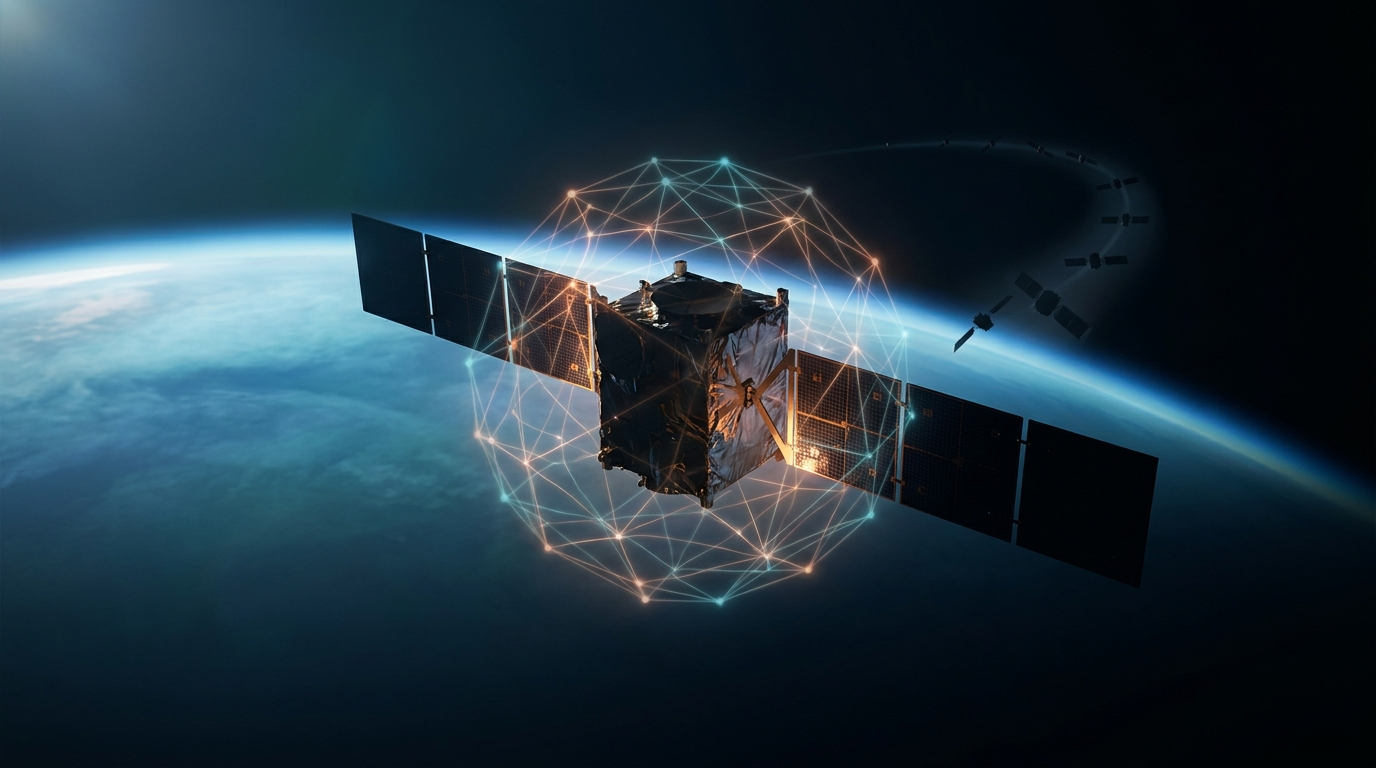
That seam is collapsing. Inside a single calendar quarter, the world's largest launch operator merged with one of its most aggressive AI labs, rebranded the whole thing as SpaceXAI, and started talking openly about intelligence as an orbital primitive. Starmind is not a satellite that talks to a model somewhere else. It is a satellite that runs the model. The inference loop closes at roughly 550 kilometres of altitude, where a Starlink V3 bus with a radiation-hardened accelerator can answer a query without ever waiting for a ground station to wake up.
The reason this feels qualitatively different from past "AI in space" demos is the shape of the convergence. Three independent curves have bent at the same time.
The first curve is bandwidth. Starlink V3 satellites, per the company's own update, are designed to deliver an order of magnitude more capacity per bird than V2. With a planned fleet in the six figures, raw global throughput enters territory that changes how AI services are architectured. Latency-bound workloads that once had to be served from nearby data centres can be served from a constellation overhead, with failover between satellites and ground stations becoming almost free.
The second curve is inference cost. Each generation of agentic foundation models is roughly an order of magnitude cheaper per token than the one before. Grok 4.5, as Reuters noted, is targeted explicitly at coding and agentic workloads, the use cases where high tool-call reliability matters more than raw benchmark numbers. Drop a small, well-tuned model into a satellite, give it a disciplined toolset, and you have something that earns its keep without paying frontier-model prices.
The third curve is rocket economics. The unit cost of putting a kilogram in low Earth orbit has dropped so far that the dominant variable in a satellite programme is no longer launch, it is the satellite itself. Launch costs have made radical designs economically legible. Six-figure constellations stop looking like science fiction when each launch is amortised across forty satellites and reusability is a daily occurrence rather than a press milestone.
The three curves meet in Starmind. The bandwidth curve gives the orbital AI node a fat pipe to every ground user. The inference curve gives that node a model that can earn money. The launch curve gives SpaceX the freedom to manufacture nodes by the tens of thousands. The integration is real, vertical, and unusually hard to replicate.
The Sceptics Have a Point, and It Is Healthy
A serious treatment of this moment cannot ignore the pushback. IEEE Spectrum published a sharp piece on the gap between orbital data centre hype and current physics, focusing on thermal rejection and silicon reliability. The Register covered the FCC pushback on the de-orbit plan for the new constellation, where orbital sustainability has become a genuine regulatory question rather than a courteous footnote. SoftBank's Masayoshi Son dismissed the orbital data centre thesis outright, pointing at terrestrial power and cooling economics that genuinely do favour ground-based builds in 2026. Ars Technica walked through the engineering checklist from first principles and confirmed it is hard, but not impossible, especially for inference-only workloads rather than full-spectrum training.
None of that falsifies the trajectory. It shapes it. The future that is actually being built is not "AI moves off-planet entirely." It is something more interesting: a tiered substrate where the most latency-sensitive inference happens on the satellite, the bulk of training happens on the ground, and the seam between them is a richly instrumented network that treats orbit as one of several tiers of compute. Goldman Sachs, in a forecast first reported by the FT, expects the AI arm of SpaceX's revenue to rise roughly a hundredfold by 2030. Even discount that for forecast optimism and you are looking at one of the largest industrial buildouts of the decade.
A New Nervous System, Off-Planet
Here is the part that should excite anyone who works in software. For the first time, we are building a planetary-scale substrate whose default mode is intelligent. Every previous infrastructure layer arrived dumb: roads, electrical grids, fibre networks, the early internet. Each had to be retrofitted with intelligence years after the concrete was poured. The orbital AI stack is being born intelligent. The router in the sky is also the inference endpoint. The antenna is also the agent. The download is also a model that has opinions about what the picture means.
That has consequences for everything from disaster response to scientific discovery. A satellite that can onboard a new geophysics model on orbit, without waiting for a ground upload, compresses the loop between observation and analysis from weeks to seconds. A constellation of such satellites becomes, in effect, a distributed planetary instrument: watching, reasoning, summarising, and forwarding compressed insight rather than raw bits. The economics favour it. The physics permit it. The politics, today, are messy, and the right answer to that is better politics rather than slower engineering.
The convergence everyone underestimated was not technical. It was organisational. A launch company that controls its own satellites, its own models, its own ground stations, and its own user base can move as one organism. That is what SpaceXAI's rebrand really signals: the end of the artificial boundary between space transport and AI product, and the start of a single vertically integrated stack that nobody else on Earth can match today.
The orbit is not getting smarter, in the poetic sense. It is getting wired up, end-to-end, with model weights sitting at the same altitude as the antennas. The cloud is learning to look down.